How to Quote a Laser Cutting Job
A laser cutting quote is the sum of material, machine time, setup, secondary operations and margin. Machine time depends on cutting length, the number of pierces, material and thickness. Material cost depends on how well the parts nest on the sheet. Get those two right and the rest of the quote follows.
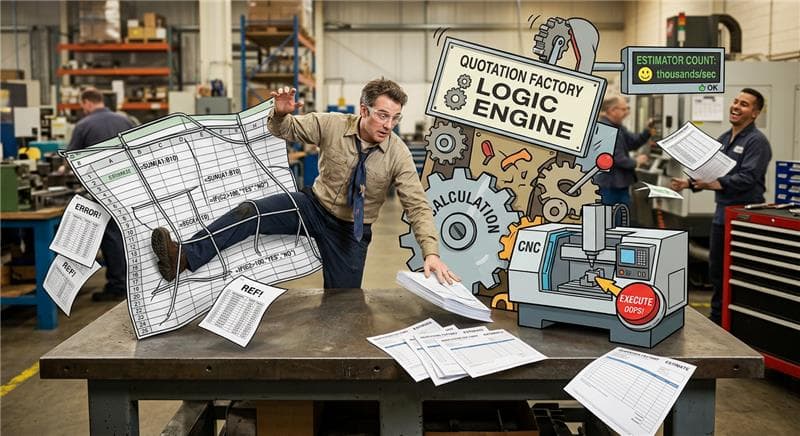
Most laser cutting shops know their machines well. The difficulty is turning a drawing into a price quickly and consistently, often for dozens of requests a week. This guide walks through the cost elements of a laser cutting quote in the order an estimator works through them, with a worked example, and then looks at what changes when the calculation is automated.
What goes into laser cutting cost and price
Every laser cutting job, from a single bracket to a batch of enclosure parts, is priced from the same building blocks:
- Material (weight, price per kilogram, sheet utilisation)
- Machine time (cutting length, pierces, speed, gas)
- Setup and programming
- Secondary operations (bending, deburring, welding, finishing)
- Margin and any customer-specific pricing rules
The sections below take them one at a time.
Step 1: Read the geometry
Before any pricing, the estimator needs to understand the part. From the drawing or the 3D model you need:
- The outer contour and the length of every internal cutout
- The number of holes and cutouts, because each one needs a pierce
- Material and thickness
- Quantity and any delivery requirements
- Tolerances and edge quality requirements
- Whether the part is flat or goes on to bending
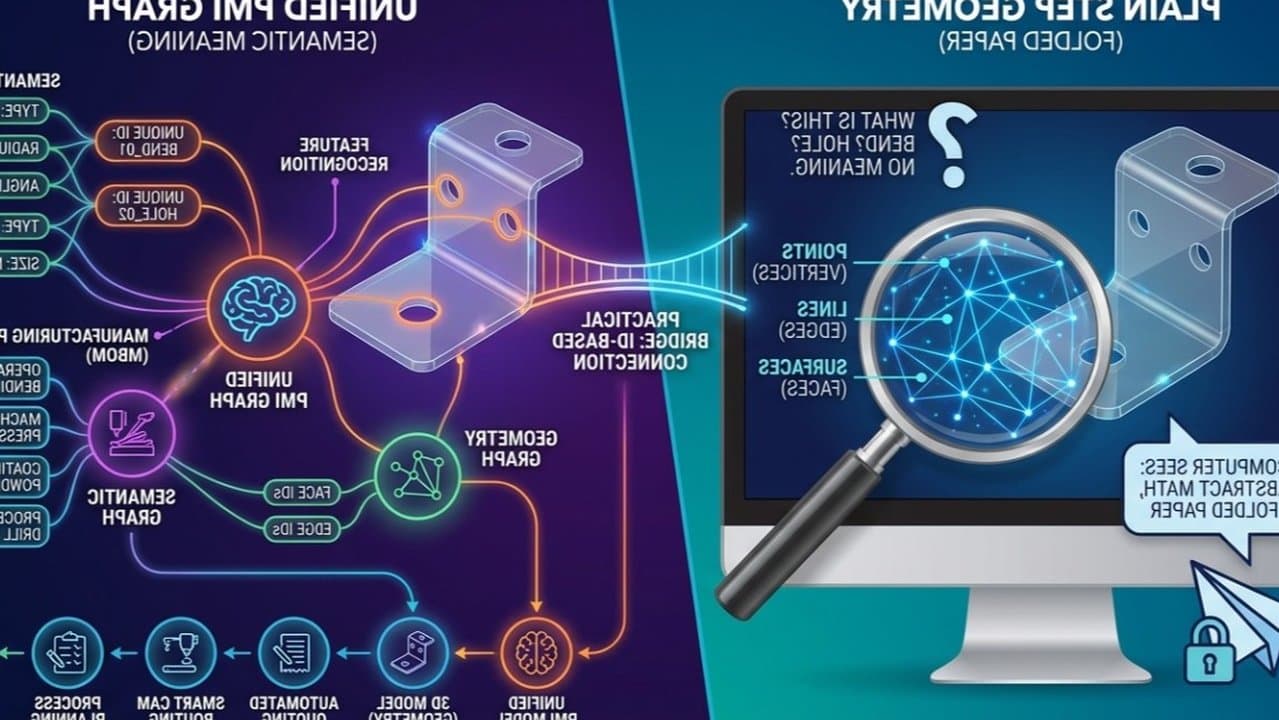
Missing or inconsistent information is the main reason quotes take long. A DXF without a material, a PDF without a thickness, or a STEP file without a quantity all lead to an email back to the customer. Starting from a 3D model or a clean DXF makes the next steps much faster.
Step 2: Cutting length and pierces
Cutting length is the total path the laser travels while cutting: the outer contour plus every internal contour. A part with many small holes can have a surprisingly long cutting length compared with a plain rectangle of the same size.
Pierces are the points where the laser first goes through the sheet before it starts cutting. Each contour needs one. Piercing takes time, and in thicker material it takes noticeably longer. A perforated plate with 400 small holes is a very different job from a plain blank, even if the weight is identical.
This is why pricing laser cutting by weight does not work. The kilos are the same, but the machine time is not. We wrote about this in more detail in estimating material consumption within the metalworking industry.
Step 3: Machine time and gas
Cutting time is, in principle, cutting length divided by cutting speed. In practice you need to take care with a few things:
- Cutting speed depends on material and thickness. The same laser cuts 1 mm stainless much faster than 12 mm mild steel. Use the speed your machine actually achieves, not the maximum on the brochure.
- Corners and small features slow the machine down. An average effective speed is more realistic than the table value.
- Pierce time and positioning moves add to the cutting time. Rapid moves between contours are short per move but add up on parts with many features.
- Assist gas (oxygen, nitrogen or air) is consumed while the laser cuts. Nitrogen for stainless steel and aluminium costs more than oxygen for mild steel, so gas cost should be tied to material and thickness.
Multiply the total machine time by your machine hourly rate. A good hourly rate covers depreciation, energy, maintenance, operator time and floor space. If you only use the lease or purchase cost, you will under-quote.
Put together, the laser cutting part of the quote looks like this:
Laser cutting cost per part = (cutting length ÷ cutting speed + pierces × pierce time) × machine rate + material ÷ sheet utilisation + setup ÷ quantity
Here "material" is the net material cost of the part, and dividing by sheet utilisation turns it into the cost of the sheet you actually pay for. Assist gas, secondary operations and margin come on top.
Step 4: Material, nesting and sheet utilisation
Material is usually the largest single cost in a laser cutting quote, and it is the one where estimators guess most.
The part's net weight is the wrong basis. You pay for the whole sheet, including the skeleton that remains after cutting. What matters is sheet utilisation: the share of the sheet that ends up as parts.
- Low utilisation (for example 60 to 65 percent) happens with large irregular parts or small quantities.
- High utilisation (80 percent or more) is possible when parts nest tightly or when different jobs share a sheet.
Estimators often apply a flat utilisation percentage per material, which is quick but inaccurate for any individual part. Running a real nesting for the quote gives a far better number, and it matters more as material prices move. Remnants add another variable: a usable offcut has value, and a shop should decide up front how it values and reuses them.
Also check whether the material is in stock or needs to be bought. Buying a full sheet for a small job changes the price, and a customer-supplied material changes it again.
Step 5: Setup and programming
Setup is a fixed cost per job, not per part: loading the sheet, preparing the program, first-part checks and unloading. For a batch of 500 it hardly shows up. For a batch of 5 it can be the largest line on the quote. Quoting setup separately and spreading it over the quantity is what makes the price per part drop as the batch grows, and it is one of the most common reasons why quantity breaks are priced inconsistently when done by hand.
Step 6: Secondary operations
A laser cut part is rarely finished at the machine. Add whatever comes next:
- Bending: setup on the press brake, number of bends, tooling changes, part handling time. A part with a complex bend sequence needs more than a part with a single bend.
- Deburring and edge finishing
- Welding and assembly
- Surface treatment, such as powder coating, galvanising or anodising. If it is subcontracted, add the subcontractor price and the extra transport and lead time.
For the sheet metal side of this, see our overview of quoting for sheet metal fabrication. If your shop also cuts tubes, the logic is similar but works on cut lengths, miters and material length optimisation instead of sheet nesting: see tube and profile quoting.
Step 7: Margin and pricing rules
The last step is the one that is hardest to keep consistent. Margin might depend on customer segment, order size, urgency, material type or workload. When two estimators add different buffers, the same job gets two different prices, and customers notice. Write your rules down and apply them in the same order every time.
Worked example (illustrative numbers)
The numbers below are made up to show the logic. Your rates, speeds and material prices will be different.
The job: 100 brackets in 3 mm mild steel. Blank size 200 x 120 mm. Cutting length of 900 mm per part, 6 pierces per part, 2 bends per part, deburring.
| Cost element | Calculation | Cost |
|---|---|---|
| Material | Blank area 0.024 m2 at 78% nesting utilisation = 0.031 m2 per part. At 23.6 kg/m2 (3 mm steel) and EUR 1.10/kg, for 100 parts | EUR 80 |
| Cutting time | 90 m total at an effective 3 m/min = 30 min. Pierces: 600 at 1 s = 10 min. Positioning: about 4 min. Total 44 min at EUR 120/h | EUR 88 |
| Assist gas | 44 min at an assumed EUR 10 per cutting hour | EUR 7 |
| Laser setup | 30 min at EUR 120/h | EUR 60 |
| Programming | 20 min at EUR 60/h | EUR 20 |
| Bending | Setup 30 min at EUR 70/h = EUR 35. 200 bends at 15 s = 50 min = EUR 58 | EUR 93 |
| Deburring | 100 parts at 20 s = 33 min at EUR 45/h | EUR 25 |
| Total cost | EUR 373 | |
| Margin | 20% | EUR 75 |
| Quote | EUR 448, or EUR 4.48 per part |
Now the same job with only 10 parts. Material, cutting and bending time drop roughly tenfold, but setup and programming stay the same. Total cost is about EUR 141, and with the same margin the quote is about EUR 169, or EUR 16.90 per part. That is almost four times the unit price, which is exactly the effect a customer asks about when they request quantity breaks.
How Much Does Laser Cutting Cost?
There is no single price, because laser cutting cost depends on the machine, the material, the thickness and the region. Any figure you find online is indicative at best, so calculate from your own rates. What you can rely on is how the price is built. Suppliers usually price in one of three ways:
- Per hour of machine time. The sound basis for costing: the hourly rate of the laser covers depreciation, energy, maintenance and operator time. It suits larger jobs and is what the formula above uses.
- Per metre of cutting length. A shortcut many shops quote from a price table by material and thickness. It is quick, but it hides pierces, positioning and nesting, so it is least accurate for parts with many small features.
- Per part. What most customers want to see. It is the result of the methods above, with setup spread over the quantity, which is why it drops as the batch grows.
The drivers behind all three are the same: thickness (thicker means slower cutting and longer pierces), material and assist gas (nitrogen costs more than oxygen), the number of pierces, sheet utilisation and batch size. For the wider picture across bending and finishing, see what factors drive the cost of a sheet metal quote.
If you are looking for a laser cutting cost calculator, the formula and worked example on this page show the logic it should implement: real cutting length and pierces from the geometry, a real nesting and your own machine rates.
Manual vs automated laser cutting quoting
Doing the calculation above by hand works for one job. It becomes a problem when volume goes up:
| Manual (Excel, experience) | Automated | |
|---|---|---|
| Cutting length and pierces | Measured or estimated per drawing | Read from the geometry |
| Nesting | Flat utilisation percentage | Calculated per job |
| Machine time | Rule of thumb per material | Calculated from machine parameters |
| Consistency between estimators | Varies | Same rules every time |
| Response time | Hours to days | Minutes |
Quotation Factory's laser cutting quoting software reads sheet metal geometry directly, including contours and piercings, nests the sheets automatically, calculates laser cutting time from your machine parameters and applies your own pricing rules. It also supports flatbed laser, punch, plasma and combination machines. If you are looking for laser quoting software, the useful questions to ask any vendor are whether it calculates from real geometry, whether the logic is transparent enough for your estimator to check and adjust, and whether it connects to your ERP and CAM systems so you do not re-enter data once the quote is confirmed.
Frequently asked questions
How do you price a laser cutting job?
Add up material, machine time (cutting length, pierces, speed and gas), setup and programming, secondary operations such as bending and finishing, and then your margin. Weight alone is not a good basis, because two parts with the same weight can have very different cutting lengths and pierce counts.
What affects laser cutting cost the most?
For most jobs it is material cost and machine time. Material depends on thickness, grade and how well the parts nest. Machine time depends on cutting length, the number of pierces and the cutting speed for that material. For small batches, setup becomes the dominant factor.
Should laser cutting be priced per hour or per part?
Calculate it per hour, then present it per part. The hourly machine rate is the sound basis for costing. The customer usually wants a price per part and quantity breaks, which you get by dividing the fixed setup cost over the batch size.
Can laser cutting quotes be automated?
Yes. Software can read the cutting length and pierces from CAD files, run a nesting for the material estimate and calculate machine time from your own parameters. The estimator then reviews exceptions instead of calculating every standard part.
See it on your own parts
If laser cutting quotes take your team hours, or two estimators give two different prices for the same part, it is worth seeing what automated quoting looks like with your own drawings. Book a demo and we will walk through a quote with you.