From Software to Agents: What the Next Leap in Metalworking Looks Like
By Wim Dijkgraaf, Founder & CEO of Quotation Factory
I have spent years thinking about how metalworking businesses can work faster, smarter, and with more consistency, without losing the craftsmanship and practical judgment that make them great.
That is why I believe we are at the start of something much bigger than another software feature.
Metalworking companies are under pressure from every angle.
Customers expect faster responses. Product complexity keeps increasing. Margins are tight. Skilled people are hard to find. And inside many businesses, a huge part of operational performance still depends on the judgment of a few experienced people in sales, work preparation, and engineering.
That has been the reality for years.
But something fundamental is starting to change.
What I believe we are seeing now is not just another layer of software or another AI feature. We are seeing the beginning of a new operating model for metalworking businesses: one in which company knowledge, specialist judgment, and day-to-day decision-making can be captured, scaled, and executed through agents.
That, to me, is the real significance of what is emerging now.
The real bottleneck in metalworking
In my view, most metalworking businesses do not suffer from a total lack of information. In fact, they often have plenty of it.
They have CAD files. Drawings. BOMs. ERP data. Routings. Historical quotes. Customer requirements. Supplier information. Shop-floor knowledge.
The real bottleneck is what has to happen in between all that information and the next correct action.
Someone has to interpret a drawing note.
Someone has to recognize that a manufacturing step is missing.
Someone has to understand whether a request fits the company’s capabilities.
Someone has to spot a risk before it becomes a costing error, a quality issue, or a production delay.
And usually, that “someone” is an experienced person.
That is why so much of this industry still runs on what I would call operational craftsmanship: people who know what to look for, what to question, what to add, and what to decide. These people are incredibly valuable, but they are also difficult to scale.
When growth depends on adding more of those people, scaling becomes slow, expensive, and fragile.
The shift from tools to execution
For years, software has helped metalworking companies structure work better. It has digitized processes, centralized data, and improved visibility.
That matters. But traditional software is still mostly passive. It stores, organizes, and supports.
The next step is different.
Now, AI is no longer just answering questions or generating text. It can begin to work inside real workflows. It can access context, interpret information, and trigger actions.
That changes the conversation entirely.
Because the real promise is not that AI can “chat” about a project. The real promise, as I see it, is that it can participate in the operational flow of the business.
Create a project. Read the available context. Review item details. Compare drawing notes to planned working steps. Identify gaps. Suggest or execute next actions.
That is a very different category of capability.
It means software is no longer just a system people use. It starts becoming part of how work gets done.
The biggest opportunity: scaling expertise
This is where the impact for metalworking businesses becomes especially powerful.
In almost every successful metalworking company I know, there are people with highly specific knowledge that makes the company better. A work preparer who immediately spots a manufacturability issue. A salesperson who knows which jobs fit the business and which ones do not. A specialist who understands exactly how drawing notes should translate into process steps. Someone who knows when a finishing requirement is routine and when it will create hidden cost.
That knowledge is gold.
But in most companies, it lives in fragmented form: in people’s heads, in habits, in spreadsheets, in exceptions, in side notes, in informal checks, in “the way we usually do it.”
The problem is not that this knowledge lacks value. The problem is that it is difficult to capture and nearly impossible to scale consistently.
This is where agentic systems change the game.
For the first time, companies can begin turning that specialist knowledge into reusable operational skills. Not generic rules imposed from the outside, but company-specific intelligence based on how that business actually works.
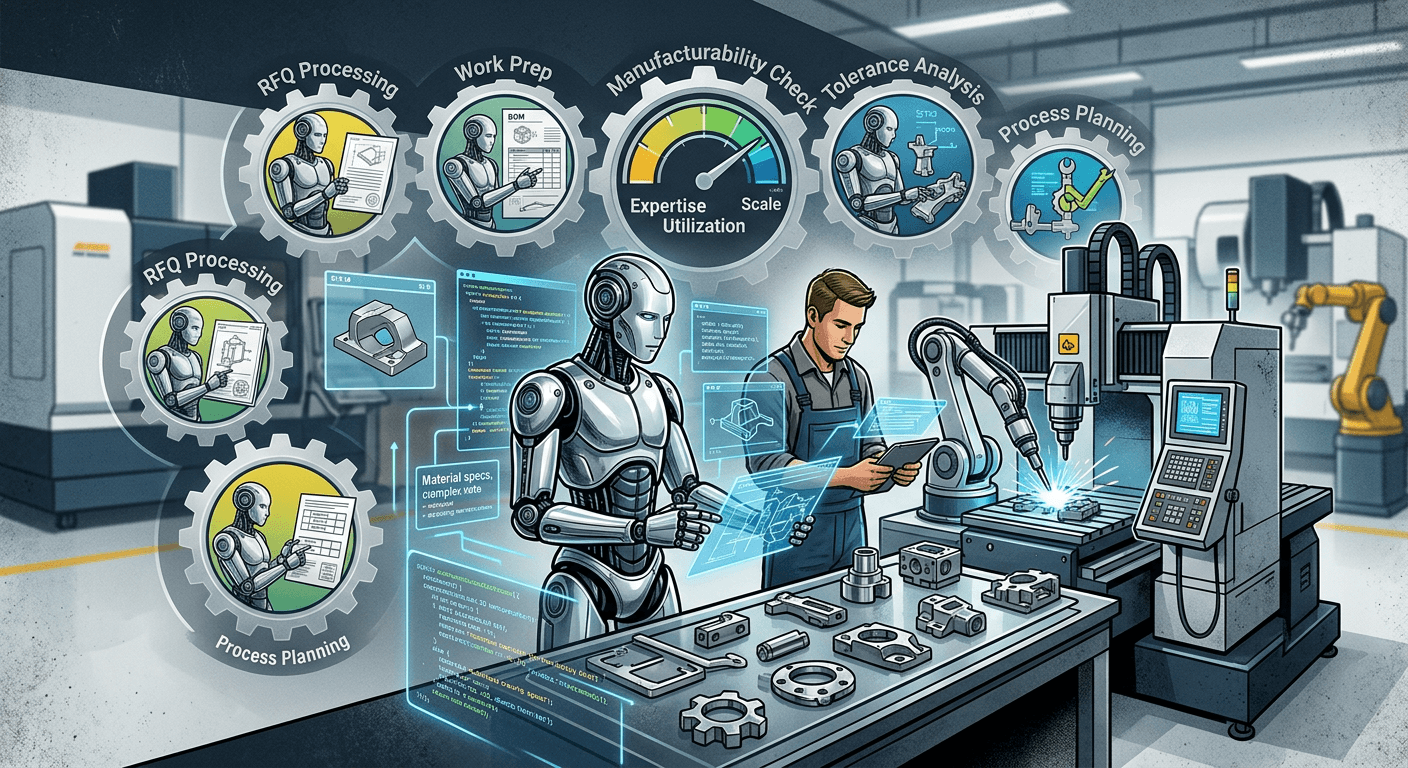
A metalworking company could define skills such as:
- checking whether routing steps match drawing notes
- reviewing items from a surface-treatment perspective
- flagging tolerance-related risks
- assessing manufacturability of incoming RFQs
- creating projects automatically from mailbox requests
- escalating only the uncertain or exceptional cases to human experts
This is the real breakthrough.
It is not just automation of tasks. It is the ability to scale judgment.
Why this matters so much in metalworking
This shift is especially important in metalworking because metalworking is not a simple, repetitive environment.
It is a high-variation industry. A high-mix industry. An industry where details matter enormously.
A small note on a drawing can affect lead time, process choice, cost, risk, and quality. A missing deburring step is not just an oversight; it can have downstream consequences for production, finishing, assembly, customer satisfaction, and margin.
And that is precisely why so much value sits in the hands of experienced people who know how to read between the lines.
At the same time, those same companies are under growing pressure to respond faster. Customers want speed. Markets want flexibility. Businesses need consistency. But faster manual work often means more risk, not less.
That is the tension metalworking companies live with today: speed versus accuracy, efficiency versus expertise, growth versus dependence on scarce specialists.
I believe agentic systems offer a way through that tension.
They allow businesses to respond faster without giving up depth. They allow expertise to be applied more consistently. And they help companies handle complexity without relying on endless manual checking.
This is not about replacing people
Whenever AI enters an industry, people immediately ask the same question: does this replace jobs?
I think that is the wrong frame here.
In metalworking, the real opportunity is not to remove human expertise. It is to multiply its impact.
The best companies do not want less judgment. They want more of it, applied more consistently, across more work, without overloading the same small group of specialists.
That is what makes this so powerful.
An experienced work preparer should not have to spend hours every week repeating the same checks that could be captured and executed by an agent. A specialist should not have to manually inspect every routine case if a system can handle the obvious ones and escalate the uncertain ones.
That is not replacement. That is leverage.
The winners in this next phase will not be the companies that choose between people and AI. They will be the companies that combine craftsmanship with agentic execution.
Human expertise will remain essential. But it will be used at a higher level: for exceptions, decisions, improvement, customer interaction, and strategic judgment. The repetitive interpretation work can increasingly be delegated.
More flexible than business rules, more practical than spreadsheets
Many companies have already tried to solve complexity through business rules, custom configuration, or spreadsheets.
That approach works up to a point.
But real manufacturing judgment is rarely clean and rigid. It depends on context. It depends on combinations of signals. It depends on nuance. It depends on experience.
That is where static rules often become brittle. Companies either create too many of them, making the system hard to manage, or they keep too much of the real logic outside the system in Excel sheets and manual review.
Neither scales well.
The more powerful model is different.
Use your core platform for what it does best: structure, process control, transactional reliability, and operational data.
Then use agents for what they do best: interpretation, specialization, nuance, and execution of company-specific knowledge.
That is, in my opinion, a much more natural fit for the reality of metalworking.
The platform becomes the backbone.
The agents become the specialists.
And together, they create a much stronger operating model than either could alone.
A digital workforce for metalworking
This is why I do not think the conversation should stop at “AI features.”
What is emerging is the beginning of a digital workforce.
Imagine a flow where one agent monitors incoming requests, another creates projects, another checks manufacturing completeness, another reviews finishing requirements, another flags unusual tolerances, and another prepares the right context for a human reviewer.
That is no longer science fiction. It is becoming operationally possible.
And what makes it especially powerful is that these agents do not need to be generic. They can reflect the actual specialisms of a specific metalworking business.
Every company has its own standards, preferences, capabilities, trade-offs, and best practices. Those differences matter. They are often part of why one business performs better than another.
So the future is not just that every company gets AI. The future is that every company can begin building its own operational intelligence layer.
That is where strategic advantage will come from.
Why early adopters will pull ahead
As with every important shift, timing matters.
The companies that begin early will not only gain access to new tools. They will gain experience in how to apply them. They will learn which skills matter most, where the biggest operational gains are, how to structure review loops, and how to combine human experts with autonomous agents in a practical way.
That learning compounds.
The businesses that start early will be the ones defining the playbook. They will build confidence, internal understanding, and real competitive advantage before others are even organized enough to begin.
And in a market where responsiveness, consistency, and specialist capability matter so much, that head start will be significant.
This is one of those moments where waiting feels safe, but actually creates risk.
Because once this model works, it will not be a marginal improvement. It will be a step change.
The next era of metalworking
Metalworking has already gone through earlier waves of digitization. Systems became more connected. Data became more available. Processes became more visible.
The next era will go further.
It will not just be digital. It will be agentic.
That means systems that do not only store information, but use it. Systems that do not only support decisions, but participate in execution. Systems that allow the knowledge of your best people to be captured, reused, improved, and scaled across the business.
That is why this moment matters to me.
Not because of one demo.
Not because of one connector.
And not because AI is fashionable.
It matters because metalworking businesses now have the opportunity to scale expertise in a way that was not previously possible.
And I believe that may turn out to be one of the biggest operational shifts the industry has seen in years.
Quotation Factory is not simply adding AI to metalworking. We are helping open the door to what I believe is the first truly agentic operating model for the industry.