Unified PMI: The Missing Link in Today's Factory Digitalization
Most factories are trying to digitalize their machines. Very few are truly digitalizing their information.
That gap is exactly where Unified PMI lives.
What is PMI – and why doesn't it work (yet)?
PMI stands for Product and Manufacturing Information. In an ideal world, all of this lives in one place: a 3D CAD model with:
- Geometry
- Dimensions and tolerances (GD&T)
- Surface finishes
- Thread and hole specs
- All relevant manufacturing notes
That concept is called Model Based Definition (MBD): your 3D model becomes the single source of truth for engineering and manufacturing.
Standards like STEP AP242 and QIF were created to make this possible.
In theory, we'd all already be working like this.
In practice?
- Many customers still send 2D PDFs
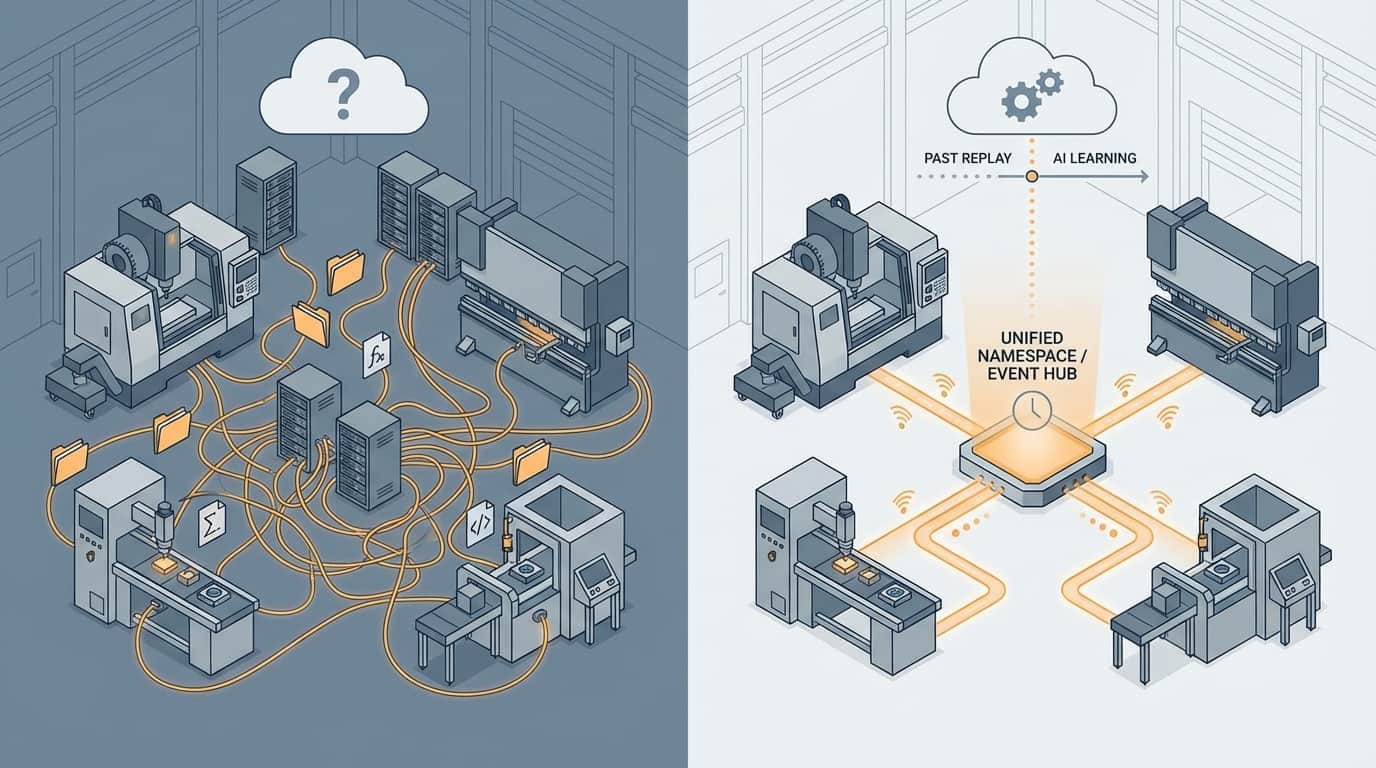
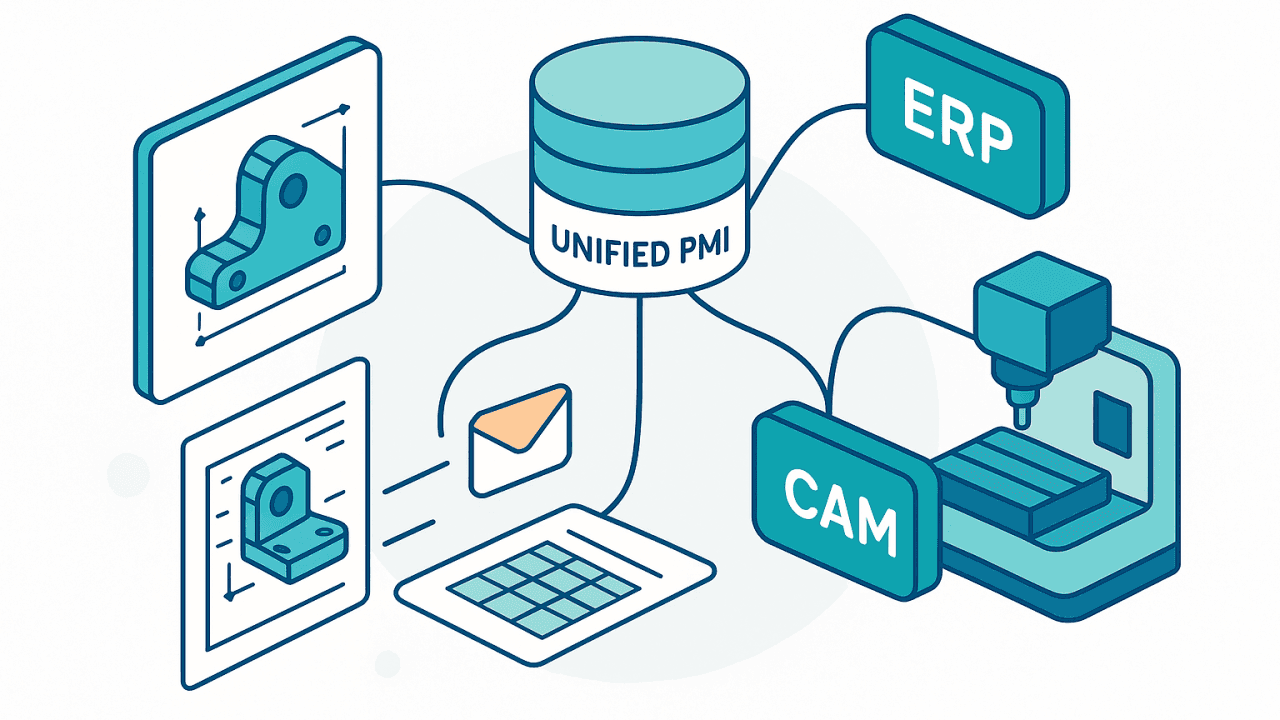
- Info is scattered across emails, Excel, Word, drawings and STEP files
- ERP and CAM systems often can�t fully use the rich PMI in 3D models
- Adoption is slow – even world-class OEMs struggle to move their full supply chain to MBD
So we're in a long transition phase: the standards exist, but your daily reality is still a mix of old and new worlds.
The real problem: fragmented input, manual translation
If you run a mid-sized metalworking company, this probably sounds familiar:
- An RFQ comes in with:
- An estimator opens everything, tries to understand:
- They manually:
- The result:
The problem is not that you lack software. It�s that your product & manufacturing information is fragmented and unstructured.
Unified PMI: a pragmatic bridge to the digital factory
Unified PMI is our answer to that reality.
Instead of waiting for the world to magically go "100% MBD", we build a unified data model that brings all Product & Manufacturing Information together - regardless of its original source.
Concretely, Unified PMI means:
One standardized data model for all product & manufacturing information, even if it arrives as "old-school" PDFs, emails or Excel sheets.
From the live demo in the transcript, here's what this looks like in Quotation Factory today:
- You upload:
- The system:
- That information becomes:
Step by step, we're rebuilding an MBD-like model on your side - even if the customer only sends traditional drawings.
Why this matters: the causal chain
Once your input is transformed into Unified PMI, several good things become almost inevitable:
- Structured input → predictable processing If every BOM item has structured PMI (material, thickness, tap specs, tolerances, etc.), your system can reason about manufacturability instead of relying on tribal knowledge.
- Predictable processing → reliable, automated estimations With Unified PMI, Quotation Factory can:
- Reliable estimations → faster, consistent quoting You can:
- Unified PMI → clean integration into ERP and CAM Because information is standardized, you can:
- Clean integration → scalable, less people-dependent operation Your business no longer collapses when one senior estimator is on holiday. You're building a system that can scale, not just adding more heroic problem-solvers.
Average teams vs. top teams
Average teams in metalworking:
- Wait for customers to "finally" send proper MBD
- Keep patching the process with extra spreadsheets and manual checks
- Rely on a few people who "just know" how to read messy specs
- Talk about digitalization mainly in terms of new machines
Top teams:
- Accept that input will stay mixed (3D + 2D + PDFs + emails) for years
- Build a translation layer: one Unified PMI model that everything flows into
- Design their factory processes around structured, reusable information
- Use automation not just at the machine, but from inquiry to order
Quotation Factory is built for those top teams: mid-sized metalworking companies that want to move beyond heroic effort and build a scalable quoting and production engine on top of Unified PMI.
What Unified PMI changes for you (in business terms)
For a 20–100 FTE metalworking company, Unified PMI is not an abstract data concept. It translates into very concrete business value:
- Shorter quote lead times Less manual interpretation → more RFQs handled → higher conversion.
- Higher and more predictable win rates Consistent pricing, faster feedback, better perceived reliability.
- Lower dependency on scarce experts Knowledge moves into the system instead of staying in people's heads.
- Fewer shop floor surprises Because specs and operations are derived from one coherent data model, not from five different documents.
- A realistic path toward full MBD in the future When more customers start sending proper MBD, you're ready - but you don't have to wait for them to clean up their act.
A calm next step
If you're working in a metalworking company and recognize the daily struggle with scattered specs, drawings, emails and models:
You don't need a revolution. You need a unified way to capture and use the information you already receive.
That's what Unified PMI is about.
If you'd like to see how Unified PMI would look on your drawings and assemblies, send me a message and we can walk through a real example from your factory.