State Machines - the Hidden Engine of Every Digital-First Metalworking Company
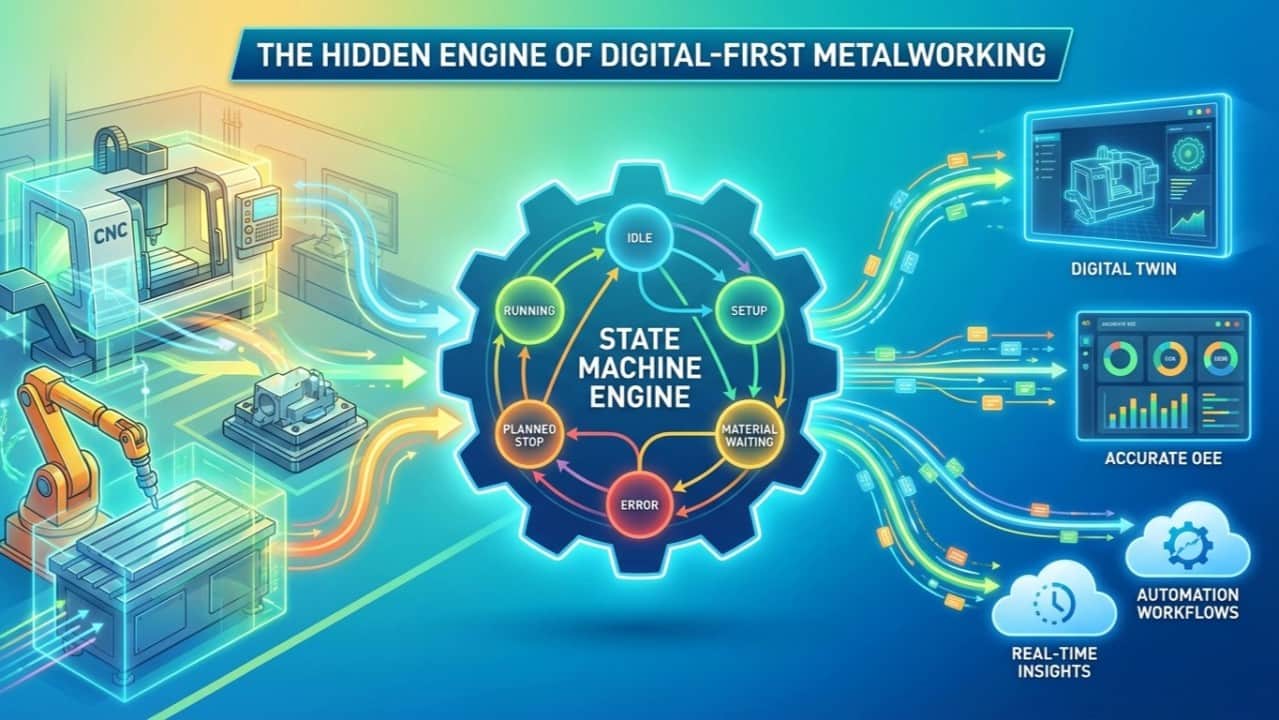
State machines are the foundational concept that determines whether your digital transformation succeeds or fails. They model how machines cycle through states (Idle, Running, Setup, Downtime, etc.) following clear, defined rules-acting as a digital operator that never forgets, never misses an event, and never misinterprets what happened. If you want accurate OEE, real-time insight, meaningful automation, and a reliable digital twin, you must first understand and implement state machines.
In the metalworking industry, digitalization often gets associated with buzzwords like IoT, Industry 4.0, AI, or Smart Factory. But beneath all those technologies sits one foundational concept that quietly determines whether your digital journey succeeds or fails:
State machines. The logic that defines how a factory truly behaves.
What Is a State Machine, Really?
A state machine is a simple but powerful model describing the current condition of something and how it can change.
In a metalworking environment, a machine doesn’t just “run” or “stop”. It cycles through states such as:
- Idle
- Running
- Setup / Changeover
- Planned stop
- Unplanned downtime
- Error / Alarm
- Material waiting
A state machine ensures that these transitions follow clear, defined rules - just like the physical process itself. It’s essentially a digital operator that never forgets, never misses an event, and never misinterprets what happened.
Why Digital-First Manufacturing Depends on State Machines
A digital-first factory has three non-negotiable requirements:
- Everything must be observable.
- Everything must be modeled.
- Everything must be consistent.
State machines are the mechanism that makes all three possible.
They allow machines, products, workflows, and even operators to be represented as clean, predictable state models. When something changes - a button pressed, a sensor triggered, a program completed - the state machine updates instantly and logs the transition.
This creates a real-time, reliable digital twin of the factory.
The OEE Problem: Why Most Companies Measure It Wrong
Most metalworking companies still rely on:
- spreadsheets
- operator notes
- manually entered downtime codes
- incomplete logs
- assumptions and guesswork
Which leads to:
inaccurate OEE unknown causes of downtime discussions on the shop floor: “Was the machine really down?” action plans based on opinions instead of evidence
The root cause is simple:
Without a state machine, you do not have accurate machine states. Without accurate machine states, you cannot have accurate OEE.
A state machine automatically logs:
- every state
- every transition
- every reason
- every timestamp
No discussion. No interpretation. Just truth.
How State Machines Enable a True Digital Twin
A digital twin is not a 3D model or a fancy visualization. It is a live representation of the real-world state of your equipment and processes.
State machines turn reality into data by:
- listening to events (machine signals, barcode scans, operator actions)
- updating the digital state instantly
- triggering workflows (alerts, maintenance tasks, production flows)
- writing a complete historical log of behavior
This means your factory becomes:
- predictable
- analyzable
- automatable
- improvable
Exactly what “Industry 4.0” has promised for years.
Practical Impact for Metalworking Companies
Here’s what companies typically experience when they adopt event-driven state machines:
1. A dramatic increase in machine availability Because you can finally see why machines stop - and how often.
2. Shorter lead times Bottlenecks become visible within hours, not months.
3. More reliable OEE Because downtime is no longer subjective.
4. Automation becomes achievable Workflows can now be triggered by states and events.
5. Higher trust between management and the shop floor Facts replace debates. Operators feel supported, not blamed.
The State Machine as the Foundation of a Digital Workflow Engine
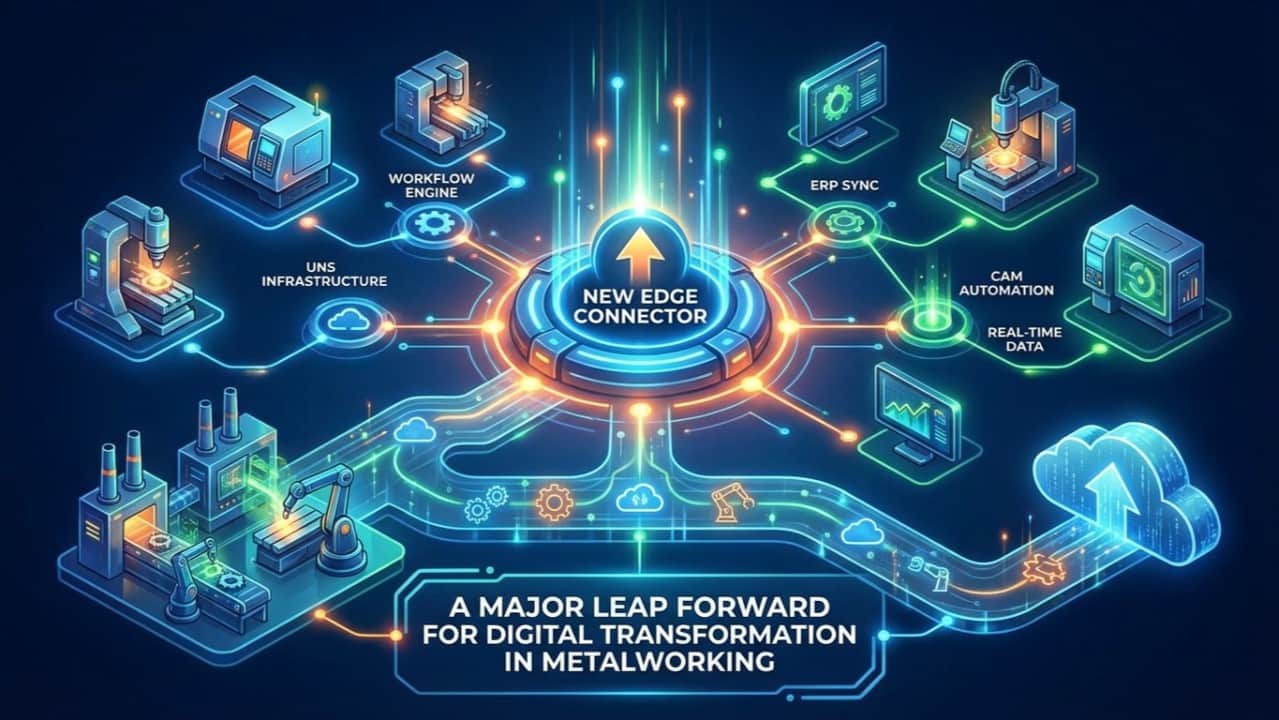
Modern edge devices - like our newest Edge Connector - include workflow engines that allow you to model:
- sequences
- complex workflows
- and full state machines
All driven by events published on an MQTT server.
This means machines, products, and processes can:
- react to events
- emit events
- trigger workflows
- synchronize their states
- log everything
Creating a fully event-driven, fully observable factory floor.
Conclusion: You Can’t Be Digital-First Without State Machines
If your goal is to build a modern, data-driven, automated metalworking operation, then:
State machines are not optional.
They are the backbone of:
- digital twins
- Industry 4.0
- reliable OEE
- workflow automation
- predictive maintenance
- paperless factories
- real-time dashboards
They transform your factory from a black box into a transparent, measurable system.
A digital-first metalworking company isn’t built with dashboards - it’s built with state machines, events, and workflow logic.
And once those are in place, everything else becomes possible.