Unified PMI: A Pragmatic Path from Drawing Chaos to Model-Based Working
Most conversations about factory digitalisation today end up in the same place:
“We need to move to Model Based Definition (MBD) and Model Based Engineering (MBE).” And they’re right… in theory.
But if you run a metalworking business, your daily reality probably looks more like this:
- One customer sends only an email
- Another sends a 2D drawing + email
- Another sends 3D model + PDF drawing + email + Excel
- And almost nobody sends a clean, usable MBD model
So the question becomes:
How do you move towards a model-based future… while working in a completely hybrid, messy present?
That’s where the idea of Unified PMI comes in.
PMI: the bridge between product and manufacturing
PMI stands for Product and Manufacturing Information.
In simple terms, it’s all the information you cannot see just by looking at the 3D shape:
- Tolerances
- Materials
- Surface finishes
- Operations / process steps
- Notes and special requirements
A 3D model alone might tell you what the end result looks like. PMI is what allows you to define how it should be made and how it should be checked.
MBD tries to embed all of this PMI directly into the 3D model. That’s powerful – but it assumes the world is already ready to work that way.
Most of the supply chain isn’t.
Engineering BoM vs Manufacturing BoM: two different worlds
To understand Unified PMI, we first need to separate two perspectives:
1. Engineering BoM (EBOM)
- Focuses on what the product is
- Composition, structure, functions, properties
- Typical view of an engineer or machine builder
- “Is it fit for purpose? Does it solve the problem?”
2. Manufacturing BoM (MBOM)
- Focuses on how the product is made
- Routes, operations, times, machines, operators
- How assemblies are built up over multiple steps
- The world of the metalworking supplier
In an EBOM, time and sequence do not really exist. In an MBOM, they are everything.
For a metalworking company, the challenge is always:
Transform an engineering BoM into a manufacturing BoM using incomplete, mixed-format information.
That transformation is where most of the manual work, risk and variability live.
Why the final model is not enough
Even if you had a perfect MBD model of the final product, you still face a practical issue:
You don’t manufacture the final state in one step.
You move from:
- Raw plate or bar →
- Cut part →
- Machined part →
- Tapped / formed / welded part →
- Coated and assembled product
Each step has a different intermediate state of the product.
For CAM, quality, and planning you need models and data that reflect:
- How the part looks at that specific moment in the route
- Which features already exist (holes, threads, countersinks…)
- Which tolerances and requirements are relevant at that stage
Example:
- The laser cutting program doesn’t need to know about thread specs.
- The tapping operation absolutely does.
- An in-process quality measurement must reflect the state after cutting but before welding or coating.
So the real challenge is not just: “Can I get an MBD model of the final product?”
It’s: “Can I have the right model and the right PMI for each step along the manufacturing route?”
The real world: hybrid input, fragmented information
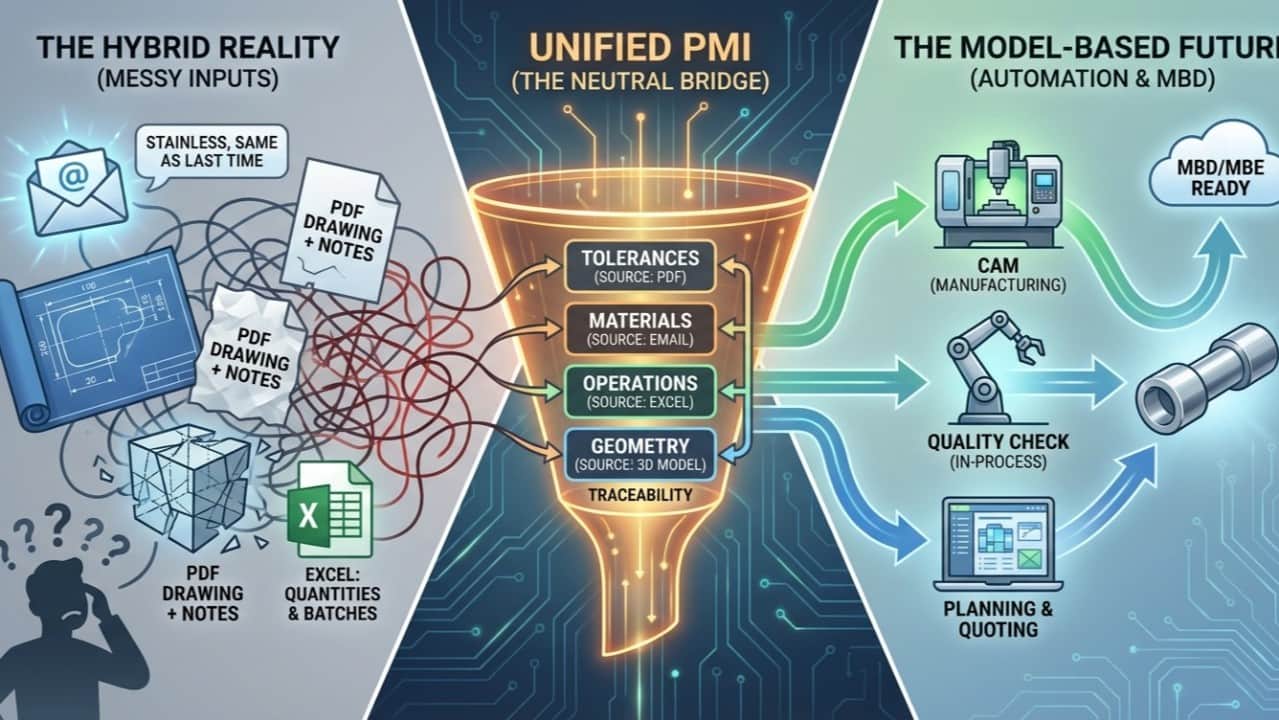
Now combine all of that with the actual input you get as a supplier:
- Email saying “material must be stainless, same as last time”
- PDF drawing with dimensions and some tolerances
- 2D DXF for laser cutting
- 3D STEP model of the end result
- Excel sheet with quantities and delivery batches
And on top of that, you have CAM systems that:
- Sometimes support MBD “a bit”
- Often expect their own formats
- Rarely consume the full richness of PMI directly
Waiting for the whole world to send perfect, standardised MBD models is not a strategy. You need something that works today, with the input you already get.
Unified PMI: a pragmatic, hybrid approach
Unified PMI is how we at Quotation Factory approach this problem.
The idea in one sentence:
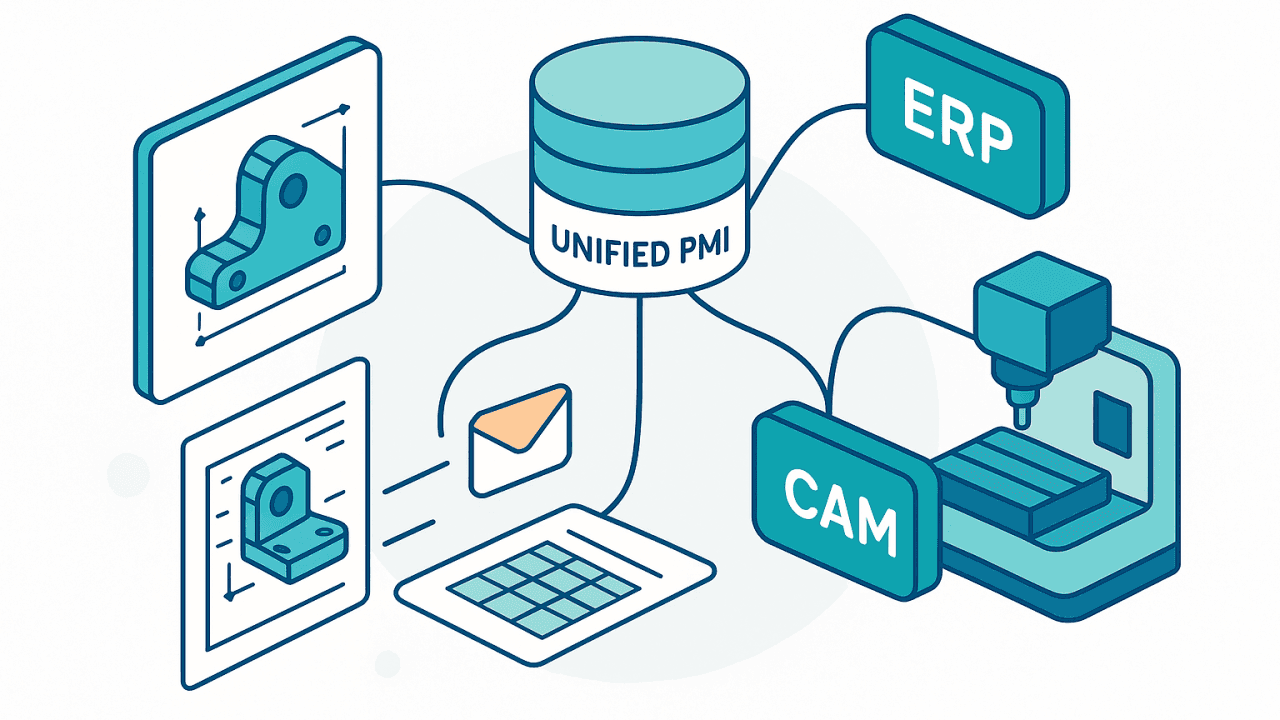
Unified PMI is a neutral, standardised data model for all Product & Manufacturing Information, independent of the original source – but with full traceability back to that source.
Concretely, that means:
- We don’t insist that all PMI must live inside the 3D model
- Instead, we build a Unified PMI model next to it
- In that model, we capture:
…and for each piece of information, we keep a link to the original source:
- This material spec came from an email
- This tolerance came from the PDF drawing
- This thread spec came from a note in the 2D model
You still have your 3D model(s). You still have your PDFs and emails.
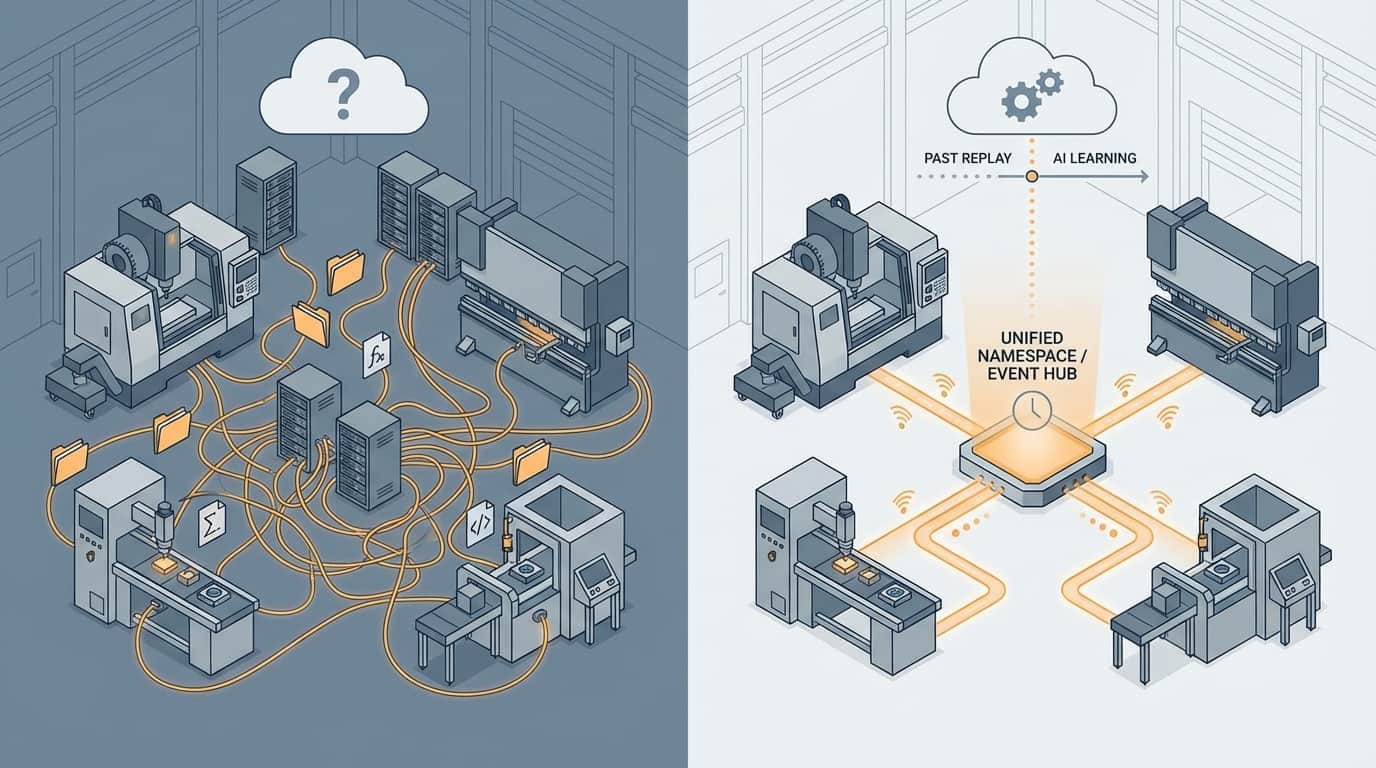
But for automation and digitalisation, you now work against one coherent, unified PMI layer.
How Unified PMI connects to MBD and CAM
Once you have Unified PMI as a separate, traceable data model, you get options:
- If your CAM system understands MBD → we can generate an MBD model from the Unified PMI and 3D geometry.
- If your CAM system does not support MBD well → we can use the Unified PMI directly to drive:
Over time, with feature recognition and route definition, we can also:
- Reconstruct how the 3D model looks at different stages in the route
- Attach the relevant subset of Unified PMI to each intermediate state
- Support in-process quality checks with the right model at the right moment
This is not “MBD or nothing”. It’s a hybrid model that helps the supply chain move step by step towards a model-based way of working, without pretending that everything is already there.
Why this matters for metalworking businesses
For owners of metalworking companies, Unified PMI is not about data models for their own sake.
It’s about making a few crucial things possible:
- A smoother transition from document-driven to model-driven working
- Less manual interpretation of mixed input (mail, 2D, 3D, PDFs, Excel)
- A clearer separation – and connection – between:
- Better input for CAM and quality at each step in the route
- A realistic path towards MBD/MBE, instead of an all-or-nothing leap
Unified PMI treats today’s hybrid reality as a given – and still moves you in the right direction.
What’s next
This article is the introduction to a short video series where I’ll go deeper into:
- How Unified PMI looks in practice inside Quotation Factory
- How we handle traceability between documents and the unified data model
- How we use feature recognition and routing to connect PMI to real operations
- What this means for quoting, planning and quality control in your factory
If you run or support a metalworking business and you’re struggling to connect engineering input to a robust, digital manufacturing process:
Unified PMI might be the missing layer you’ve been looking for.
Feel free to follow along, leave a question in the comments, or message me if you want to see what this looks like on your own parts and drawings.