The Supply Chain Is Not a Process. It's a Thinking Game.
Most manufacturers still talk about their process as if it's a fixed, linear thing.
Inquiry → estimate → order → production → delivery.
Neat on a whiteboard. Chaotic in real life.
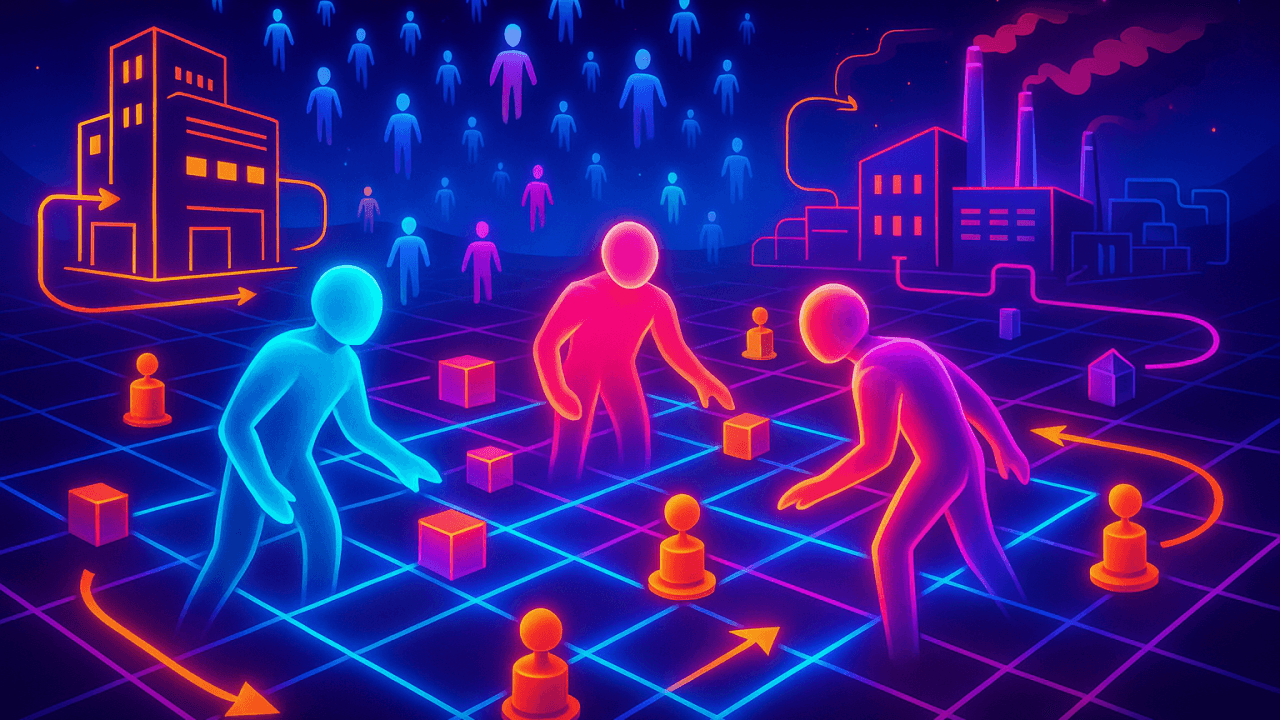
What if the real breakthrough is to stop looking at the supply chain as a process… …and start treating it as a game?
Not a game in the sense of "not serious" – but in the sense of:
- goals
- moves
- feedback
- strategy
- and learning over time
This is where AI finally starts to make sense for metalworking and manufacturing.
From video games to AI – and to your factory
There's a documentary I highly recommend: "The Thinking Game".
It follows Demis Hassabis, co-founder and CEO of DeepMind, from his childhood in chess and video games to building one of the leading AI labs in the world.
The pattern is always the same:
- Take a game (Pong, Breakout, Go, StarCraft).
- Let an AI agent play it.
- Give it a goal (win the game).
- Reward progress toward that goal.
- Let it repeat this loop millions of times.
That's reinforcement learning.
And what happened?
- The AI became better than any human at Pong and Breakout.
- AlphaGo beat the best Go players in the world – in a game so complex that humans thought creativity there was "solved".
- Later, the same ideas were used for protein folding, solving problems that have nothing to do with games on the surface.
The key insight:
Games are safe sandboxes to train intelligent behavior.
Now move from Pong and Go… …to your supply chain.
Events, expectations, and the real world
In a digital factory, there are two fundamental things:
- Events - things that happened
- Expectations - things you believe will happen
An event is a factual registration:
- Material entered the warehouse at 09:13
- A machine started a job at 10:02
- A truck left your supplier's yard at 12:45
You can store these in an event historian and replay them later:
- to simulate what happened
- to measure effects of process changes
- to train models to predict what will happen next
An expectation is something like:
- "This material will arrive at 15:00."
- "This machine will finish the job at 16:30."
- "This order will be ready on Thursday."
Expectations are generated by:
- planning
- scheduling
- forecasting algorithms
Now combine the two:
- You expect material at 15:00.
- But you also see events from the supply chain:
Based on those events, you estimate: "Will my expectation still be true?"
If the probability drops below a certain threshold…
You must adjust your expectations and re-prioritize your actions.
That is exactly where AI agents will sit in the near future.
Enter the agents – and the swarm
Imagine AI agents in your supply chain:
- each with a specific goal
- each with a certain degree of autonomy
- each reacting to events and expectations
Now imagine hundreds or thousands of those agents, all working together like a swarm:
- some watching material flows
- some watching machine capacity
- some watching customer promises
- some watching subcontractor performance
They can:
- scale up when more complexity appears
- scale down when things are quiet
- learn from history
- simulate future scenarios
We don't have "supply chain orchestrator" as a human job today. The system is simply too big, too dynamic, too fragmented.
A supply chain is not a single thing you can point at. It's the result of an ecosystem working together (or not).
Swarms of agents are the missing coordination layer that humans alone can't provide.
Why local optimization isn't enough
Think of a car.
You can buy:
- the best engine
- the best tires
- the best steering wheel
- the best exhaust
As separate components, each is "world-class".
But if they don't fit together as a system… …you don't have a car. You have a pile of expensive parts.
Most factories today are optimizing their own part:
- better machines
- better planning
- better quoting
- better internal flow
All good. But that doesn't mean the ecosystem is working better.
You can have a perfectly optimized factory… …that is still a bottleneck in the broader supply chain. Or that suffers from chaos upstream and downstream.
Local optimization without system orchestration will hit a wall.
That's why we need to look at the supply chain as a game environment, not a static process.
The game engine for the metalworking supply chain
Now translate the DeepMind pattern to manufacturing:
- Event-driven platform → your "game world"
- Events + expectations → the state of the world
- AI agents with goals → your players
- Rewards → better lead times, reliability, margins, throughput
Such a platform can:
- React in real time to what's actually happening.
- Simulate alternative futures by replaying or modifying events.
- Train agents to behave differently under new conditions.
This is exactly the kind of architecture we use at Quotation Factory:
- Based on an actor model (similar to what's used in complex games like Halo).
- Structured around events and expectations, not static records.
- Designed as a translation engine between commercial input and technical reality.
In practice, that means:
- incoming customer requests are structured and understood
- manufacturability is checked against a virtual factory
- supply chain options (internal and external) are evaluated
- estimates and quotes are generated consistently
- all of this creates a rich stream of events that can later be replayed, analyzed, and used for training agents
We're not "gamifying" the supply chain with badges and points. We're using game principles to make it controllable, learnable, and improvable.
What happens when lead time collapses?
One more uncomfortable thought.
Right now, the journey from idea → product has a certain lead time. Inside that lead time:
- a lot of waiting
- a lot of misalignment
- a lot of waste
If we treat the supply chain as a game and let AI agents orchestrate it…
We can compress that lead time drastically:
- faster decisions
- fewer surprises
- better coordination
- less friction between companies
But here's the twist:
Lead time collapses even if demand doesn't grow.
That means:
- capacity is freed up
- competition intensifies
- inefficient players are exposed
- the bar for "normal performance" moves up
This is not just a technical shift. It's a market shift.
Average teams vs. top teams
Average teams will:
- keep patching local problems
- add another spreadsheet
- push people harder during peaks
- react to disruptions one email at a time
Top teams will:
- structure input and events
- standardize how reality is captured in data
- adopt platforms that treat the supply chain as a living system
- use automation and AI agents to orchestrate the whole chain, not just their own site
Quotation Factory aims to be the partner of those top teams in metalworking and manufacturing – not by "doing AI for AI's sake", but by:
- designing the process right
- structuring commercial + technical input
- automating the repetitive
- enabling self-service where it makes sense
- and preparing the ground for agent-based orchestration when you're ready
Where to go from here
If this idea resonates with you, I'd invite you to do three things:
- Watch "The Thinking Game" and notice how often games are used as training grounds for real-world breakthroughs.
- Look at your own factory and supply chain and ask:
- Start imagining your supply chain not as a rigid process… …but as a game world in which agents can learn to play better than we thought possible.
If you want to explore what this could mean specifically for the metalworking supply chain – and how an event-driven, game-inspired architecture like Quotation Factory's could fit into your ecosystem – send me a message.
I'm happy to walk through it with you.