The Quote Factory Operating System
Rethinking High-Mix/Low-Volume Manufacturing Through the Lens of Commercial Precision
Written by Wim Dijkgraaf, Founder & CFO at Quotation Factory
Executive Summary
High-Mix/Low-Volume (HMLV) manufacturing is widely understood as a production challenge: many product variants, small batch sizes, and constant changeovers. Yet this framing is incomplete.
While manufacturing execution may indeed be HMLV, the commercial reality upstream is fundamentally different. Sales and estimation teams operate in an environment better described as:
High Mix / High Volume / High Precision
In this domain, the “volume” is not measured in shipped units, but in decision events: quotes, feasibility checks, pricing commitments, and lead time promises.
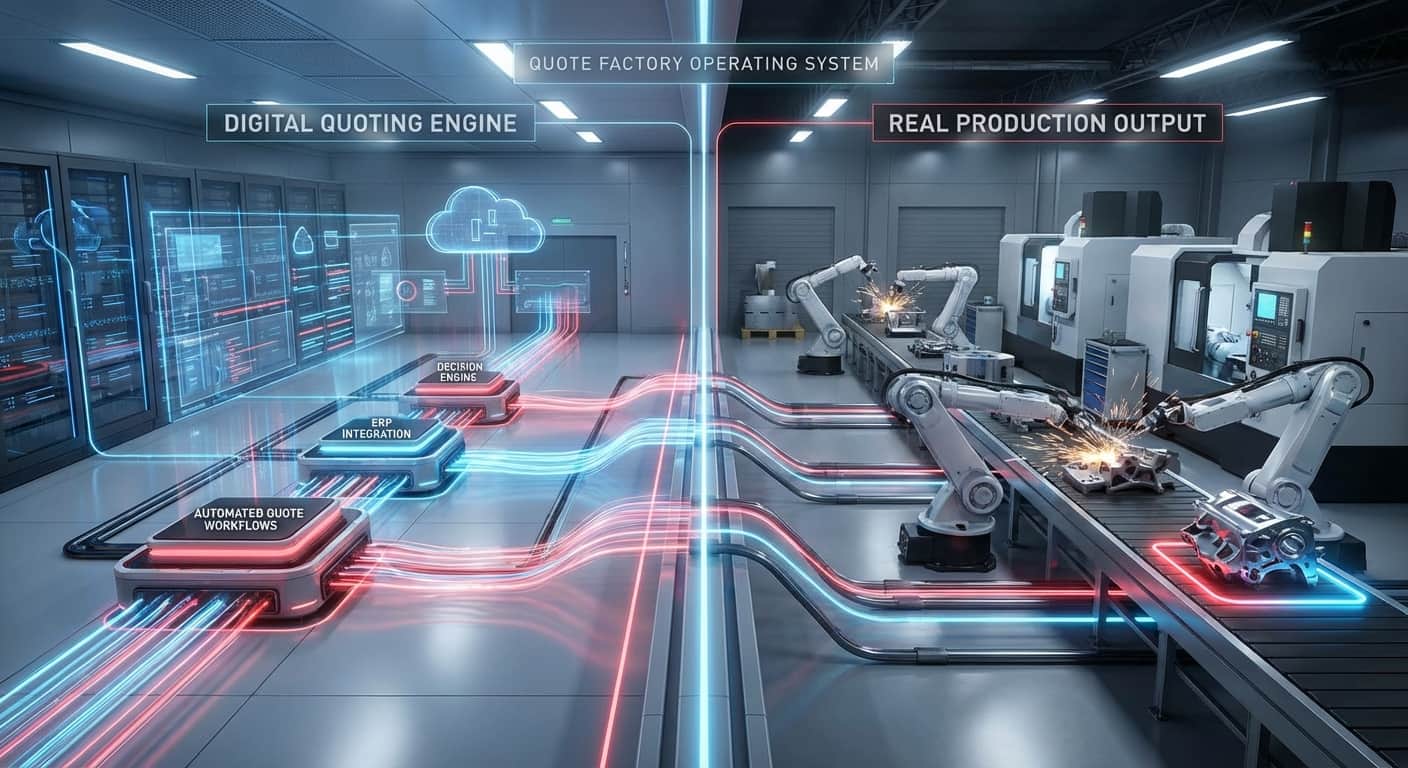
This paper introduces the concept of the Quote Factory Operating System (QFOS): a structured approach to managing quoting as an industrial-grade production process in its own right, complete with throughput metrics, precision indicators, and reuse mechanisms.
1. The Hidden Factory in HMLV Businesses
Most HMLV companies focus their improvement efforts on the shop floor:
- reducing setup time
- improving scheduling
- increasing flexibility
- managing complexity
But the true complexity often begins earlier.
Before a single part is produced, the organization must process:
- hundreds or thousands of RFQs
- unique customer requirements
- new configurations
- uncertain routings
- incomplete drawings
- volatile material pricing
The result is a structural asymmetry:
| Domain | Operational Reality |
|---|---|
| Manufacturing Execution | High Mix / Low Volume |
| Quoting & Estimation | High Mix / High Volume |
| Contract Commitments | High Precision Required |
The factory produces low volume parts.
The quote desk produces high volume commitments.
2. Why Sales is High Volume Even When Production is Not
Traditional volume thinking is based on physical output:
- number of units shipped
- batch size
- machine hours
But quoting volume is different.
Sales engineering volume is measured in:
- quote requests processed
- variants evaluated
- decision cycles completed
- pricing models executed
- lead times promised
Even if only 10% of quotes convert, the organization still performs 100% of the estimation work.
This makes quoting the highest-volume operational process in many HMLV firms.
3. Precision: The Missing Dimension
Unlike production errors, quoting errors are rarely recoverable.
A quoting mistake becomes embedded into:
- contractual pricing
- delivery expectations
- routing assumptions
- margin structures
Small deviations create large consequences:
- Underquoting destroys profitability
- Overquoting loses business
- Wrong lead time damages trust
- Wrong assumptions cause downstream chaos
Thus quoting is not merely high mix and high volume, but also:
High Precision
This is the defining feature of the commercial factory.
4. Quoting as a Prediction System, Not an Administrative Task
Manufacturing is an execution system.
Quoting is a prediction system.
Execution tolerates iteration:
- adjustments on the line
- rework loops
- process corrections
Prediction demands accuracy upfront:
- price is fixed
- lead time is promised
- scope is assumed
- risk is priced
This makes quoting comparable to:
- underwriting in insurance
- pricing desks in finance
- configuration engineering in aerospace
It is not “paperwork.”
It is operational decision manufacturing.
5. Introducing the Quote Factory Operating System (QFOS)
To compete in HMLV markets, organizations must treat quoting as an industrial system with:
- standardized inputs
- repeatable workflows
- measurable outputs
- continuous improvement loops
The Quote Factory Operating System is the structured framework that enables this.
It consists of three pillars:
Pillar 1: Quote Throughput Engine
The quote desk must operate like a production line for decisions.
Key questions:
- How fast can we respond?
- How many quotes can we process?
- Where are bottlenecks forming?
Metric: Quote Throughput (QT)
QT = Quotes Completed per Time Period
Example:
- 250 quotes/week processed
- 40 quotes/day per estimator team
Throughput is the commercial equivalent of production capacity.
Pillar 2: Precision & Commitment Quality
Speed without accuracy creates downstream cost.
Precision must be measured systematically.
Metric: Quote Precision Rate (QPR)
QPR = % of Quotes Delivered Within Realized Cost & Lead Time Boundaries
Example:
- 80% accurate within ±5% cost
- 90% accurate within ±2 days lead time
Precision is the equivalent of manufacturing yield.
Pillar 3: Knowledge Reuse & Configuration Leverage
High mix does not mean reinventing every quote.
The Quote Factory improves by capturing reusable structures:
- cost modules
- routing templates
- customer-specific logic
- historical analogues
Metric: Quote Reuse Ratio (QRR)
QRR = % of Quotes Built from Existing Modules vs Fully Manual
Example:
- 60% reuse from prior configurations
- 40% engineered from scratch
Reuse ratio is the commercial equivalent of platform manufacturing.
6. The Core Model: The Quote Factory Triangle
A Quote Factory must balance three forces:
| Dimension | Risk if Neglected |
|---|---|
| Throughput | Slow response, lost RFQs |
| Precision | Margin leakage, escalations |
| Reuse | Scaling depends on heroes |
The goal is not bureaucracy.
The goal is:
Industrial-grade quoting performance.
7. Addressing the Red Tape Critique
A common objection is:
“Are we just adding process overhead?”
The response is clear:
- This is not about more administration
- This is about reducing preventable quote waste
- This is about scaling decisions, not meetings
Structure is not red tape.
Structure is throughput protection.
Or put simply:
We don’t want more rules.
We want fewer quote failures.
8. Strategic Implication: Quoting is the Real Bottleneck
In many HMLV firms:
- machines are not fully utilized
- production is flexible enough
- capacity exists
But revenue is constrained upstream by:
- estimation speed
- pricing consistency
- knowledge fragmentation
- slow response cycles
Thus:
Scaling manufacturing requires scaling quoting first.
The first factory is the quote factory.
9. Conclusion: From HMLV to HMHPV
High-Mix/Low-Volume describes the shop floor.
But the commercial engine is:
- High Mix
- High Volume
- High Precision
Recognizing this unlocks a new operational frontier:
The Quote Factory Operating System.
In the next era of industrial competition, companies will not win only by producing parts efficiently…
They will win by producing commitments efficiently.
Appendix: Metric Dashboard Summary
| Metric | Definition | Why It Matters |
|---|---|---|
| Quote Throughput (QT) | Quotes completed per week | Measures responsiveness |
| Quote Precision Rate (QPR) | % accurate vs realized cost/lead time | Protects margin & trust |
| Quote Reuse Ratio (QRR) | % modular vs manual quotes | Enables scaling |