The Computer Is Also Human: What 2025 Taught Me About Metalworking, Software and AI
Reflections from Wim's daily Metal Minutes – live from Brazil
In metalworking we are still in love with our machines. But more and more, our real leverage sits in what you don’t see on the shop floor.
I’ve spent 2025 at a distance – living in Brazil, watching the Netherlands and the European manufacturing world from afar. That distance is useful: it makes patterns harder to ignore.
In a recent live session of Wim’s Metaal Minuten I tried to capture a few of those patterns. This article is the written version of that reflection.
1. A culture where everything feels “sensitive”
Let me start with something broader than metalworking.
From the outside, it feels like everything in Dutch communication has become hyper-sensitive. Every word seems to be weighed. If you speak too clearly or too directly, it’s “not the way we should talk to each other”.
You see the same language from politics trickling into business and marketing:
- Carefully curated terms
- Sustainability as a slogan
- Inclusivity as a checkbox
- “Green” as a marketing angle
I’m not here to judge that. But I do notice a side effect: We spend a lot of time on how things sound on LinkedIn… and much less on whether our processes, data and software still match reality.
For Quotation Factory, it’s one of the reasons we have to internationalise. The Dutch market alone is too small for a product as complex as ours – and Western European manufacturing is not exactly in a clear upward trend.
That means: we need to reduce risk. We need to look beyond one region, one culture, one way of talking about industry.
2. Metalworkers still love machines – and distrust software
Back to metal.
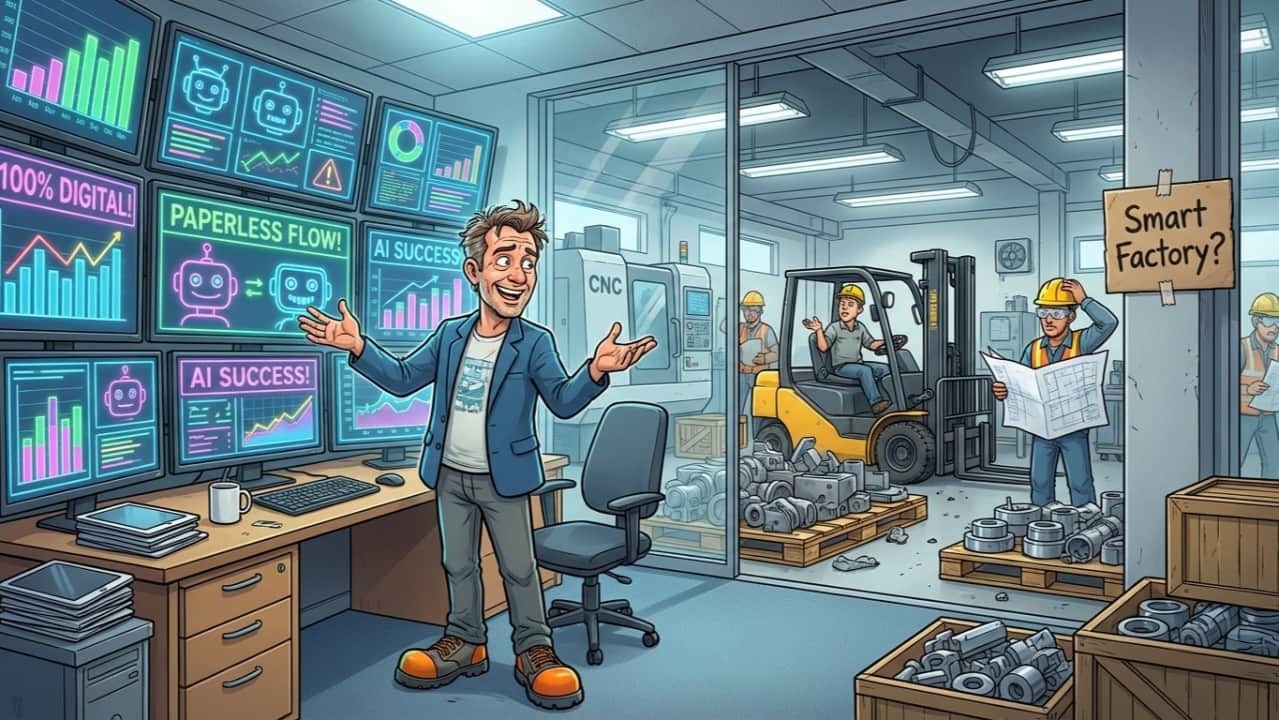
Something that still amazes me: metalworkers are deeply in love with their machines, and often have a kind of hatred or distrust towards software.
Especially companies that effectively run manufacturing-as-a-service:
- Immensely proud of parts that they did not design, but produced
- Immensely proud of the machine park which, frankly, anyone can buy if they have enough capital
I don’t mean that negatively. It’s completely natural to be proud of what you make.
But the real differentiation, especially as a service provider, is no longer:
“Which machine do you have on your floor?”
It is:
“How do you organise your processes, data and decisions – and how well is that supported by software and AI?”
And yet, what do we still see on LinkedIn?
- Photos of people proudly giving a tour of the factory
- Shots of machines, sparks, steel, noise
What we don’t see:
- The server room
- The data model
- The quoting logic
- The AI and software architecture that actually determine speed, reliability, and margin
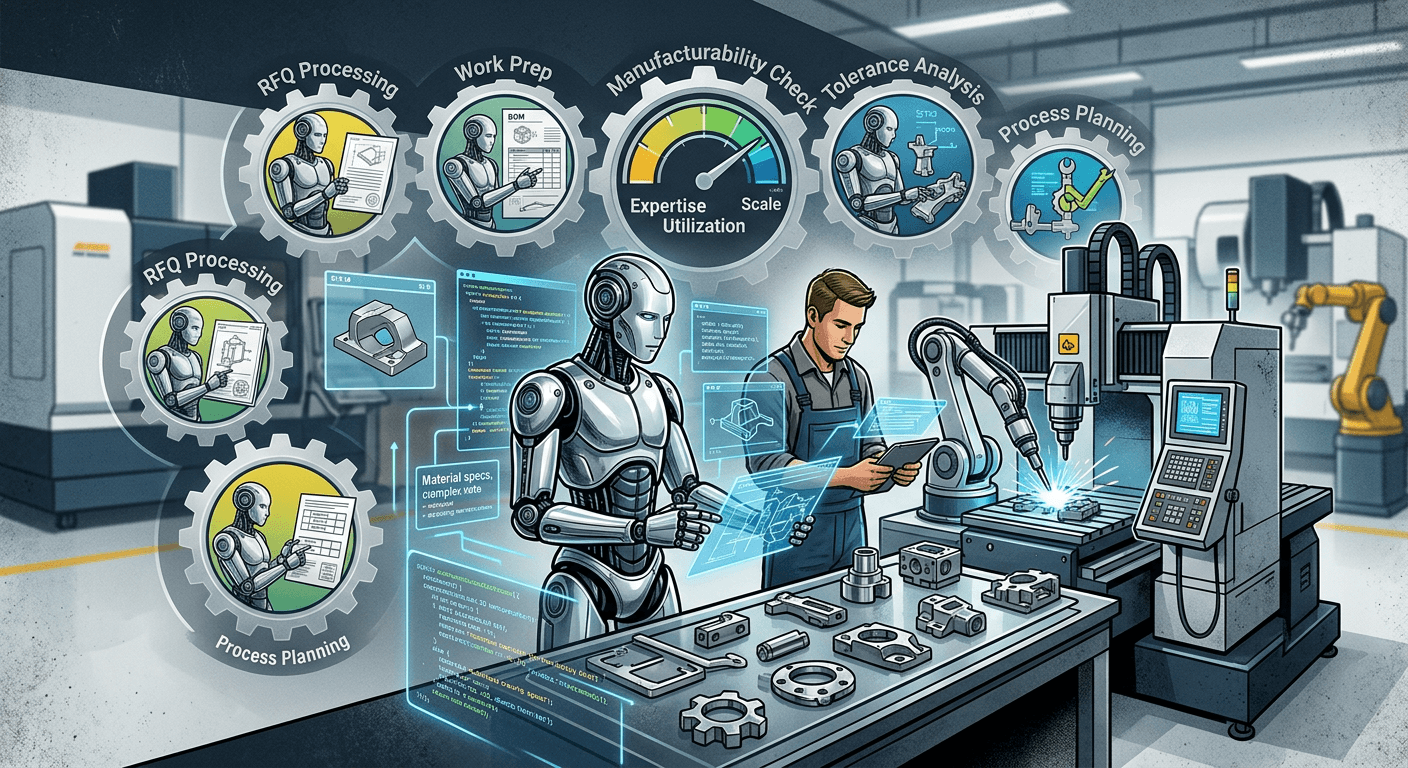
The competitive edge increasingly lives in the invisible layer: your ICT architecture, your translation from commercial input to technical reality, your ability to automate where it makes sense.
We need to find a way to make that more “sexy”. Because as long as everything is about the shop floor, we are optimising the wrong side of the business.
3. Consolidation and the art of “excelling in mediocrity”
Another clear trend in 2025: consolidation.
Metalworking shops are being bought, merged, grouped. On paper, this should create:
- More scale
- More buying power
- More alignment
- More capability to invest
In practice, what I often see is the opposite:
- Every director still runs “their own shop” inside the group
- Decisions on group level become slow and politicised
- Everything must go onto one ERP, one architecture, one template
- Energy is spent on standardising tools, not on improving the real flow of work
The result?
A group that is bigger but not more agile. More people, more tools, but less real decision power.
You end up with “excelling in mediocrity”: Systems and processes that are not disastrous, but also not remarkable. Just… average. Stable enough to not be questioned. Slow enough to block real innovation.
4. Greenfield vs. incremental improvement
Something I noticed very strongly:
- Companies that can start Greenfield – from scratch, with a blank sheet – can build something modern very fast.
- The majority tries to incrementally improve existing factories and systems.
What happens in that second group?
#They introduce new technology… but glue it on top of old principles:
- Old thinking patterns
- Old process assumptions
- Old data structures
- New tools, same logic
You get islands of modern tech, connected by the same fragile bridges as 10–15 years ago.
That’s why I keep asking:
“Can you really transform a factory purely through incremental changes? Or is it sometimes healthier to think Greenfield, build the new, and phase out the old?”
It feels safer to keep “improving what we have”. But often it’s just a way of postponing the hard decisions.
5. Young vs. “grey” management teams
Another pattern that stood out in 2025:
- Younger management teams tend to reject the status quo. They experiment, iterate, accept that not everything will work.
- Older management teams (and yes, I have grey hair too) are often more hesitant. More reports, more consultants, more analysis before taking a step.
We would never recommend learning piano by:
- following ten masterclasses,
- reading five books,
- and then not touching the keyboard.
Yet that is exactly how many companies treat digitalisation:
“Let’s first get three reports, then a roadmap, then a steering committee…”
You only really learn by doing:
- launching a first version,
- accepting mistakes,
- and building up your own digital “muscle memory”.
Consultants can help, but if you delegate your entire learning process, your learning speed will always be too low.
6. “Everyone is a software developer now” – or are they?
We just had 10+ years in which “everyone became a consultant”. Now we enter the phase where “everyone becomes a software developer”.
With AI and low/no-code:
- It’s easier than ever to build small tools.
- You can put together forms, workflows and dashboards with a prompt.
That’s great. I’m genuinely enthusiastic about this trend.
But we also have to stay realistic:
- There is still a big difference between a small internal tool and professional, scalable, business-critical software.
- A database with a few fields and a screen is not the same as a robust system to run your entire manufacturing-as-a-service flow.
My expectation: the fastest progress in software development will come from AI companies themselves.
Why?
#Because they have the strongest incentive to:
- automate programming
- automate testing
- shorten training cycles
- reduce their own dependency on human developers
If an AI company can get its own AI to build and test software faster, it can:
- re-organise its own ICT
- and train its models in shorter cycles
That incentive will drive massive improvements in how software is built. But that does not mean that suddenly “everyone” can build production-grade systems just by prompting.
We should be excited about this evolution – but not naive.
7. “The computer is also a human”
There used to be a saying:
“The computer is only human.”
Usually said when something crashed: Behind the computer sits a human who made a mistake.
With AI, that idea becomes more interesting.
Because:
- AI is not just a chatbot or large language model.
- AI is a growing family of algorithms showing up all over your software stack.
- These systems must be trained, guided and aligned with your company, your culture, your way of communicating.
In that sense, AI starts to behave more like… people:
- You onboard them
- You give them feedback
- You decide what “good performance” looks like
- You correct when behaviour drifts
The skills involved will look very similar to managing and training humans:
- clear expectations
- consistent feedback
- understanding of context and culture
In my livestream I played some AI-generated music as an example. It was fine. Background music. Elevator music.
And that is the point:
AI will help us mass-produce mediocrity at scale.
For many tasks, that’s perfectly okay:
- Standard reports
- Routine communication
- Simple tooling
But I hope we also move towards a culture that:
- values remarkable ideas,
- remarkable systems,
- remarkable stories,
- and authentic music again.
Because that is where humans (and well-designed systems) can still truly stand out.
8. Playing the infinite game
What does all this mean for metalworking and for companies like Quotation Factory?
For me, it comes back to the idea of the infinite game:
- You don’t “win” manufacturing with one big project.
- You design your organisation so you can keep playing – 5, 10, 20 years from now.
That means:
- Stop obsessing over machines alone
- Start obsessing over how commercial and technical input flows through your company
- Structure your data and decisions
- Use software and AI not as toys, but as part of a deliberate architecture
- Accept that you will need to learn-by-doing, not by endless planning
At Quotation Factory, that is exactly where we focus: on the translation engine between customer and supplier, on process design and automation, on making sure both sides can keep working in their own environment – while the underlying system removes friction.
Closing thought
AI will make it easier than ever to be average.
The question for metalworking companies in the coming years is:
“Do we want to be fast at being average… or do we want to invest in the systems, skills and structures that allow us to be truly remarkable?”
If you’re in metalworking and recognise parts of this, I’d be curious to hear:
- Where are you still “hugging your machines”?
- Where are you already starting to “love your software”?
Feel free to share your thoughts or examples in the comments.