Proposal for the Standardization of Event-Driven Architectures in the Manufacturing Industry
Submitted to: TNO Institute, The Netherlands Submitted by: Wim Dijkgraaf, Quotation Factory B.V. Date: 01/08/2025
1. Executive Summary
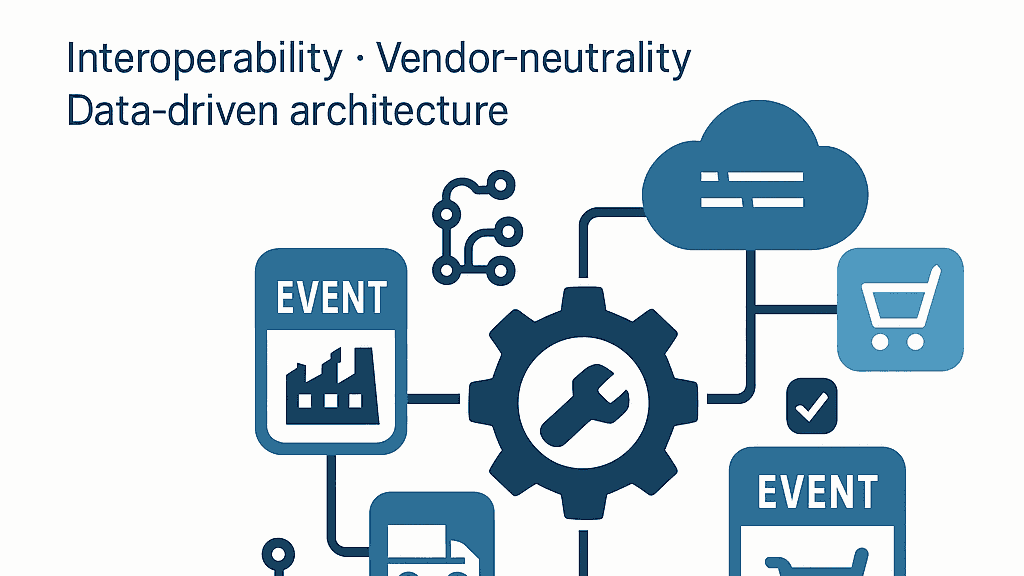
The digital transformation of the manufacturing industry is fundamentally dependent on the ability to observe, interpret, and act upon what occurs in the physical and business domains. Modern approaches such as Unified Namespace (UNS) have emerged as critical architectural patterns, facilitating real-time, event-driven integration of machines, systems, and business processes. However, the lack of standardized event definitions across domains and disciplines is a significant barrier to interoperability, vendor neutrality, and data-driven innovation.
This proposal advocates for the development of a comprehensive standard for event-driven architectures in manufacturing, focusing specifically on the documentation and standardization of the most relevant events across multiple viewpoints (operational, business, analytics, etc.). The envisioned standard will serve as a foundation for simplifying system interoperability, enabling advanced applications (including AI Agents), facilitating monitoring and analytics, and driving cross-company and cross-domain performance benchmarking.
2. Background & Motivation
2.1 The Rise of Event-Driven Architectures
Industry 4.0 and digital transformation strategies recognize that real-world actions�events�are the primary drivers of value. Capturing and communicating these events (e.g., machine state changes, order issuance, shipment deliveries) in real-time is essential for:
- Agile and autonomous operations
- Efficient system integrations
- Advanced analytics and AI applications
The UNS (Unified Namespace) concept embodies this by organizing all relevant industrial information (including events) in a central, accessible way, typically via MQTT or similar protocols.
2.2 Pain Points & Gaps
- Lack of Consistent Event Definitions: While domain-specific standards exist (e.g., PackML for machine states, UBL for commerce), there is no overarching framework for harmonizing and cross-referencing these event types.
- Integration Complexity: System integration currently requires significant custom mapping and translation between proprietary event types.
- Barriers to AI and Analytics: Specialized AI Agents and analytics tools cannot easily subscribe to or interpret events from disparate systems.
- Obstacles to Benchmarking: Comparing process and business performance between companies or sites is hindered by non-uniform event semantics.
3. Proposal Overview
We propose to establish a new cross-domain standard for event-driven architecture in the manufacturing sector, with the following objectives:
3.1 Standardised Event Catalogue
Identify and document the most relevant and recurrent industrial events across key domains (production, order management, logistics, maintenance, energy, etc.). Reference existing standards where applicable (PackML for operational events, UBL for business events), harmonizing and extending as needed.
3.2 Multi-Disciplinary Modeling
Ensure that each event is contextualized from multiple viewpoints (operator, business analyst, system integrator, AI Agent) with clear semantics and data payload specifications.
3.3 Enabler for Unified Namespace and Beyond
Specify how standardized events populate and organize a UNS-based system, forming the backbone of real-time data integration.
4. Added Value and Impact
4.1 Simplified Systems Integration
Reduces custom integration effort via common event definitions, interfaces, and translation rules.
4.2 AI Agent Enablement
Allows specialized AI Agents to subscribe to and act on specific, well-defined events, enabling more powerful, reusable, and domain-neutral AI solutions.
4.3 Monitoring and Historian Applications
Provides monitoring and analytics tools with consistent, comprehensive event logs (historians), enhancing root cause analysis, KPI tracking, and continuous improvement initiatives.
4.4 Cross-Company Benchmarking
Standardized events enable meaningful process comparisons and benchmarking, regardless of underlying information systems or ERP/MES platforms.
4.5 Foundation for a Data-Driven Ecosystem
Establishes events as primary units of digital observation, accelerating digital transformation and the move towards autonomous, event-driven enterprises.
5. Work Plan
- Landscape Assessment: Survey and analyze existing event standards (e.g., PackML, UBL) and integration practices.
- Stakeholder Engagement: Collaborate with manufacturers, solution providers, standards bodies, and domain experts.
- Drafting the Event Catalogue: Identify, document, and model key events across disciplines.
- Semantics and Payload Standardization: Define payload structures, event attributes, and hierarchy.
- Reference Implementations: Develop libraries/examples for common systems (e.g., UNS, OPC UA, MQTT).
- Validation and Pilots: Test the standard in real-world manufacturing environments.
- Dissemination and Promotion: Coordinate with industry associations to ensure broad adoption.
6. Conclusion
A standardized, event-driven approach will be the linchpin for the next generation of manufacturing digital transformation. By focusing on what happens in reality and expressing it in a unified, interoperable way, we unlock the true power of industrial data and AI for the entire ecosystem.
We look forward to TNO�s partnership in shaping this critical foundation for the smart factories of tomorrow.
Contact: Wim Dijkgraaf Quotation Factory B.V. wim.dijkgraaf@quotationfactory.com