If you still pay six figures a year for ERP/CRM/PLM/MES licenses and “implementation partners”, this is for you.
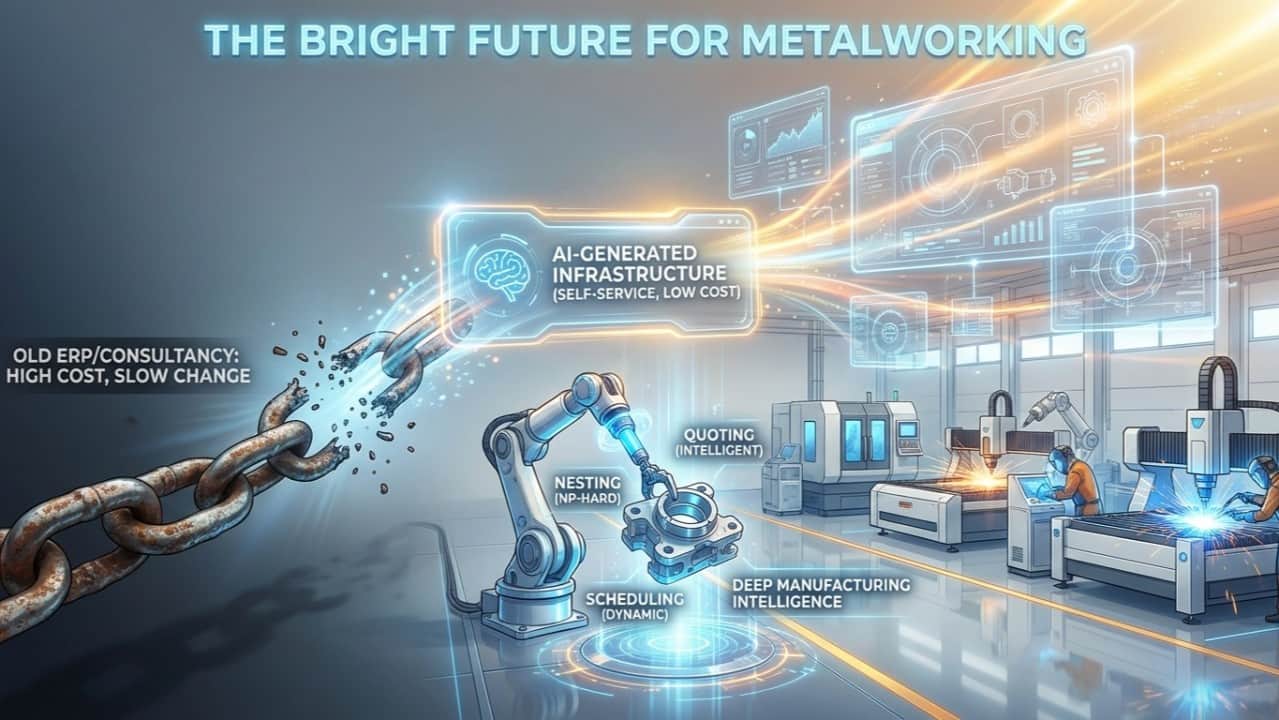
Commercial ERP, CRM, PLM and MES as you know them today are doomed-and that's good news for metalworking companies. In reality, you're just buying a database, some business rules, and screens with fields, yet paying recurring license fees, consultant day rates, and change request fees. The future belongs to open-source databases, low-code platforms, composable software, and AI agents that write code-allowing you to own your digital infrastructure instead of renting it forever. Because the uncomfortable truth is: commercial ERP, CRM, PLM and MES – as you know them today – are doomed.
And that’s good news for metalworking companies.
The real problem isn’t your ERP. It’s what you’re buying.
On paper, you’re buying:
- ERP for planning and stock
- CRM for customer interaction
- PLM for product data
- MES for shop-floor control
In reality, you’re buying three very simple things over and over again:
- A database
- Some business rules
- A screen with fields and dashboards
That’s it.
From an IT architecture perspective, your ERP, CRM, PLM and MES are basically the same product with different labels on the screens and slightly different tables underneath.
And yet you’re paying:
- recurring license fees
- day rates for consultants
- change request fees every time you want a new field, report or workflow
You’re not paying for intelligence. You’re paying for “dumb software” + a service model around it.
How most metalworking companies work today
If this feels familiar, you’re not alone:
- You choose an ERP / CRM / MES that “fits 80%”
- You hire an implementation partner for the remaining 20%
- You run workshops, mapping sessions, configuration
- Every new information need becomes:
- Meanwhile, Excel and email quietly carry the real work:
Whenever your business changes, the software lags behind. So you adapt to the system instead of the system adapting to you.
This made sense 10–15 years ago. It doesn’t in the age of AI.
What changes with modern AI?
We’re entering a world where generative AI can build the “dumb” part of your software for you:
- You describe your business objects in plain language:
- AI turns that into:
Want an extra field?
“Add a field ‘material surcharge factor’ to the part and show it in the quotation screen.”
Done.
Want simple logic?
“If material is stainless, suggest this surcharge factor.”
Done.
This is exactly what most business information systems do today – but slower, more expensive, and locked behind consultants.
The core insight:
The architecture of business information systems is generic. AI is very good at generating generic things.
So the part you used to buy as ERP/CRM/PLM/MES “product + consulting” becomes:
- generated on demand
- customized in minutes
- owned and controlled by you
The business model around “we’ll configure your screens for you” simply doesn’t survive that.
Where real value remains: the hard problems
Not everything is trivial.
There are still domains where software needs real intelligence:
- nesting in 1D / 2D / 3D
- complex scheduling
- interpreting 2D/3D models
- mapping geometry to machine capabilities and cutting strategies
- building reliable, automated cost estimations
These are not just “fields on a screen”. These are NP-hard or expert-level problems – the kind where:
- more computing time → better result
- domain knowledge really matters
- small improvements have big financial impact (material usage, lead time, machine utilization, win rate)
That is where specialized solutions like Quotation Factory live: not in being yet another “system”, but in providing deep manufacturing intelligence that plugs into whatever information layer you use.
The causal chain: why your software bill will shrink
Put it all together and the future looks like this:
- AI auto-generates your business information system
- You extend and adjust it yourself in minutes
- Licensing becomes a commodity
- Consultancy demand collapses for standard work
- Budget moves to true intelligence
- Metalworking companies regain control
The result: 👉 You pay far less for licenses 👉 You stop paying for basic consultancy 👉 You move faster than your competitors
Average vs top performers in this new world
Average companies will:
- cling to their current ERP “because we’ve invested so much”
- keep paying consultants for every adjustment
- run shadow processes in Excel “for now”
- wonder why their costs stay high and their speed doesn’t improve
Top-performing companies will:
- accept that ERP/CRM/PLM/MES are infrastructure, not strategy
- let AI generate the generic information layer
- plug in specialized intelligence for:
- treat software as something they can shape in real time around their operations
They won’t brag about their ERP brand. They’ll brag about:
- how fast they respond to new customer requirements
- how little manual work is left in their quoting and work prep
- how stable their margins are, even with complex inquiries
So what does this mean for you?
If you’re a metalworking company owner or director, it might be worth asking:
- How much are we really paying for generic business information?
- How much time and money disappears into “implementation” and “change requests”?
- If our team could adjust fields, workflows and simple logic in minutes – what would we still need external consultants for?
- What part of our digital stack actually requires real manufacturing intelligence – and are we investing there?
Because the future is not “no systems”. The future is:
Generic information systems you can generate and adapt yourself, plus specialized intelligence modules that actually move the needle.
If you want to explore what this could look like in a metalworking environment – where quoting, nesting and manufacturability checks are the real bottlenecks – send me a message.
I’m happy to walk you through how this shift away from license + consultancy and towards intelligence + self-service might play out in your factory over the next 24 months.