Everything Becomes Self-Service – But Not How You Think
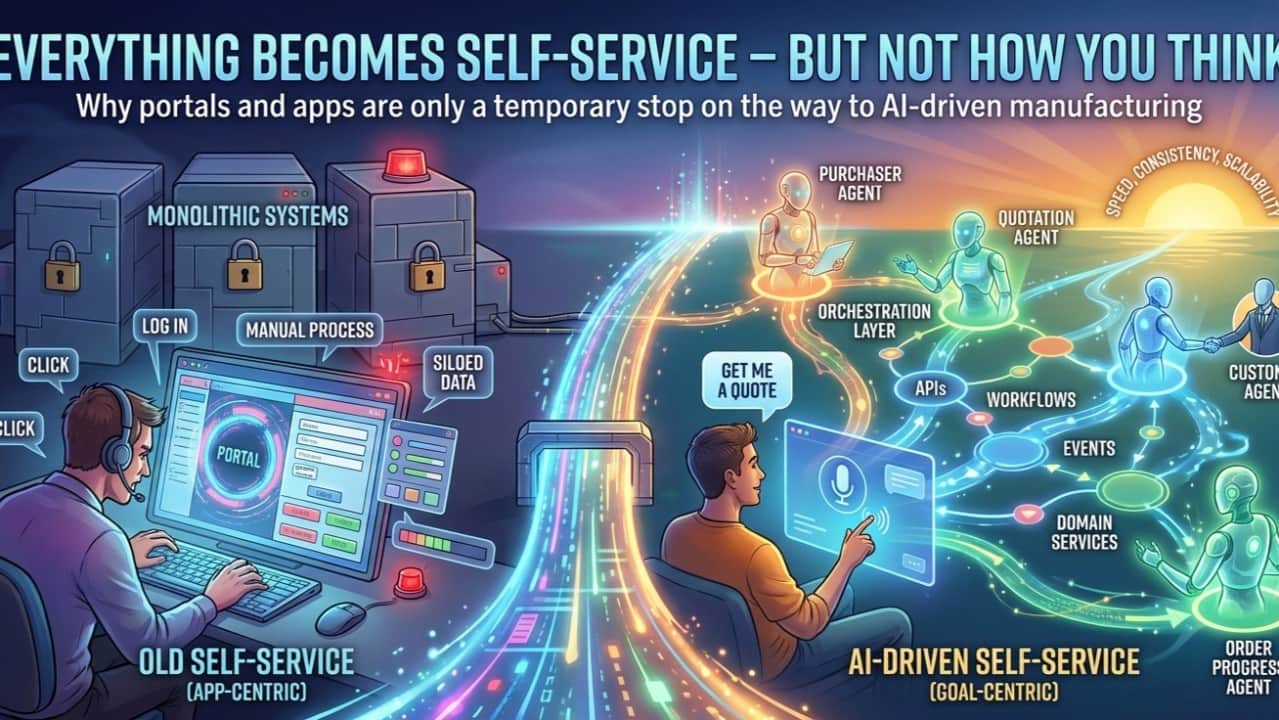
Everything becomes self-service, but not through portals humans click through-the future is AI agents serving as intelligent delegates that understand your needs, navigate complexity, interact with supplier systems directly, and make decisions on your behalf. Portals and apps are temporary stops on the way to true AI-driven manufacturing where the "self" doing the "service" is an AI acting for you.
Why portals and apps are only a temporary stop on the way to AI-driven manufacturing
For years, "self-service" has meant one thing:
A customer logs into your portal, clicks through your screens, follows your process.
We’re on the edge of a shift where apps, portals and even app stores will start to disappear from the way we actually work.
And that has huge implications for how manufacturers and metalworking companies should think about digitalisation in the next 2–5 years.
The real problem with today’s “self-service”
Most companies think the problem is:
“We don’t have a good portal or app yet.”
So they start a project: new customer portal, new supplier platform, new internal app for sales or purchasing.
But the real problem is deeper:
- Your process is still locked inside monolithic systems
- Your logic is embedded in UIs and forms
- Your data is hard to reach for anything other than the app it lives in
In other words: today’s self-service is still application-centric, not goal-centric.
The customer (or colleague) doesn’t actually want to use your portal. They just want to achieve an outcome: get a quote, place an order, secure capacity, confirm delivery.
We’ve been translating that desired outcome into “screens and clicks”. AI is about to remove that translation layer completely.
How we work today – and why it doesn’t scale
If you look at a typical metalworking or manufacturing setup today, it often looks like this:
- Customers send drawings, PDFs, STEP files via email or upload them to your portal
- Someone checks the input, translates it into your internal formats and rules
- Quoting, engineering, purchasing and planning each work in their own systems
- Integrations exist, but are fragile, slow, or highly customised
- Every change in process means more UI changes, more training, more IT tickets
The result:
- Latency between input and decision
- Friction for users (both customers and colleagues)
- Rigid processes that are hard to adapt when the market changes
We’ve automated around the edges, but we have not changed the fundamental model:
“People click through software to make things happen.”
That’s exactly the model AI agents will disrupt.
Enter AI agents: digital “colleagues” with a job to do
Think of an AI agent not as a chatbot, but as a digital function in your organisation.
For example:
- A Purchaser Agent that continuously compares prices, checks lead times, places orders within defined rules
- A Quotation Agent that turns structured input into consistent, fast quotes
- An Order Progress Agent that monitors production and proactively updates customers or escalates when something slips
An AI agent has:
- A clear role and responsibility (just like a human employee)
- Access to data, APIs and events
- The ability to observe, reason, decide and act
- A certain level of autonomy, with a human in the loop where needed
Functionally, it’s not so different from a human colleague: it needs context, tools, rules, and feedback to improve.
The big differences:
- It can operate 24/7
- It can scale up and down on demand (10 agents today, 3 tomorrow)
- It’s likely to be orders of magnitude cheaper per “FTE equivalent” for repetitive tasks
This is not science fiction. In the coming 1–2 years, you’ll be able to “buy” and configure specialised agents for specific industries and workflows – including metalworking.
Self-service in three waves
If everything becomes self-service, who is actually “serving themselves”?
You can think of it in three waves:
1. People self-serve – but without traditional apps
Instead of logging into portals and clicking through forms, users will:
- Talk or chat with an AI interface
- Describe their goal (“Get me a quote for these parts”, “Reorder last batch”, “Find capacity for next month”)
- Have the AI dynamically assemble the right steps, services and logic behind the scenes
The “app” is generated on the fly as a conversation and deleted again. No one sees screens. They see results.
2. Agents self-serve
Next, your own agents will start:
- Requesting data
- Triggering workflows
- Negotiating with external services
- Calling your internal services through APIs
They will “self-serve” from your digital infrastructure exactly the way a good employee uses your systems today – only faster and at scale.
3. Agents talk to agents
Finally, your customers’ and suppliers’ agents will talk directly to yours.
Example:
- Your customer builds a purchasing agent
- That agent needs metal components within certain specs, price brackets and lead times
- It reaches out (via APIs / protocols like the Model Context Protocol) to your services and agents
- The entire RFQ → quote → order → confirmation flow happens agent-to-agent, with humans only stepping in when something unusual happens
No login. No portal. No email ping-pong.
Just machine-readable, goal-oriented collaboration.
If apps disappear, what replaces them?
This doesn’t mean software disappears. It means the shape of software changes.
You will still need:
- Databases for storage
- Workflow engines
- Rule engines
- Pub/Sub systems for events
- Domain services like:
The difference is:
- These become services with clear APIs, not just features hidden inside an app
- They are orchestrated by workflows and agents, not by humans clicking screens
- They are combined dynamically to serve a goal, rather than statically packaged in a monolithic application
On top of these services, you need an orchestration layer:
- Where workflows can be defined, versioned, tested and observed
- Where agents can be configured, trained and launched
- Where events are captured and routed
- Where both humans and agents can interact with the same underlying capabilities
This orchestration layer is where your real digitalisation investment should go in the coming years.
The causal chain: why this leads to better outcomes
When you shift focus from “apps and portals” to “services + agents + orchestration”, a few things happen:
- Input becomes structured by design – Drawings, models, and descriptions are processed consistently by specialised services.
- Processing becomes predictable – Workflows define the path, agents handle the complexity and volume.
- Decisions become faster and more reliable – Agents act within rules and escalate exceptions, instead of humans scanning emails and attachments.
- Customers experience true self-service – They (or their agents) express intent, and the system does the rest.
- Your organisation becomes more adaptable – You can change workflows and services without rebuilding full applications and retraining everyone.
Speed, consistency, scalability: they become a natural consequence of the architecture, not another change programme.
Average vs. top teams: two very different futures
Average teams will:
- Keep patching existing portals
- Add “some AI” to their current UI
- Treat agents as a chatbot bolted onto old systems
- Keep their core logic trapped inside monolithic apps
They’ll get incremental efficiency, but they’ll hit a ceiling fast.
Top teams will:
- Design a digital infrastructure where people and agents are first-class users
- Invest in APIs, workflows, events and orchestration
- Expose their capabilities as services that can be consumed by any agent
- Think in terms of roles, responsibilities and flows, not screens and modules
Those are the companies that will be easy to do business with – for both humans and machines.
What this means for Quotation Factory (and for you)
At Quotation Factory, we started in the world of “classic” self-service:
- Customers upload drawings
- The system helps generate quotes
- Metalworking companies get a scalable quoting and order intake flow
We are now moving rapidly toward a world where:
- Our capabilities (e.g. drawing recognition, feature extraction, costing logic, workflows) exist as modular services
- Agents can interact with our platform through open protocols and APIs
- Manufacturers can plug Quotation Factory into their broader orchestration layer, not just use it as a standalone app
In other words: we’re evolving from “a system you log into” towards “an engine your people and your agents can build on”.
A simple question to end with
If you look at your digital roadmap today, ask yourself:
“Are we still investing in portals and apps – or are we designing the infrastructure that people and agents will use to work with us?”
If you want to explore what an agent-ready, self-service infrastructure could look like for your factory or supply chain, I’m happy to think it through with you.
Just send me a message here on LinkedIn.