ERP Is Doomed – Especially in High-Mix, Low-Volume Manufacturing
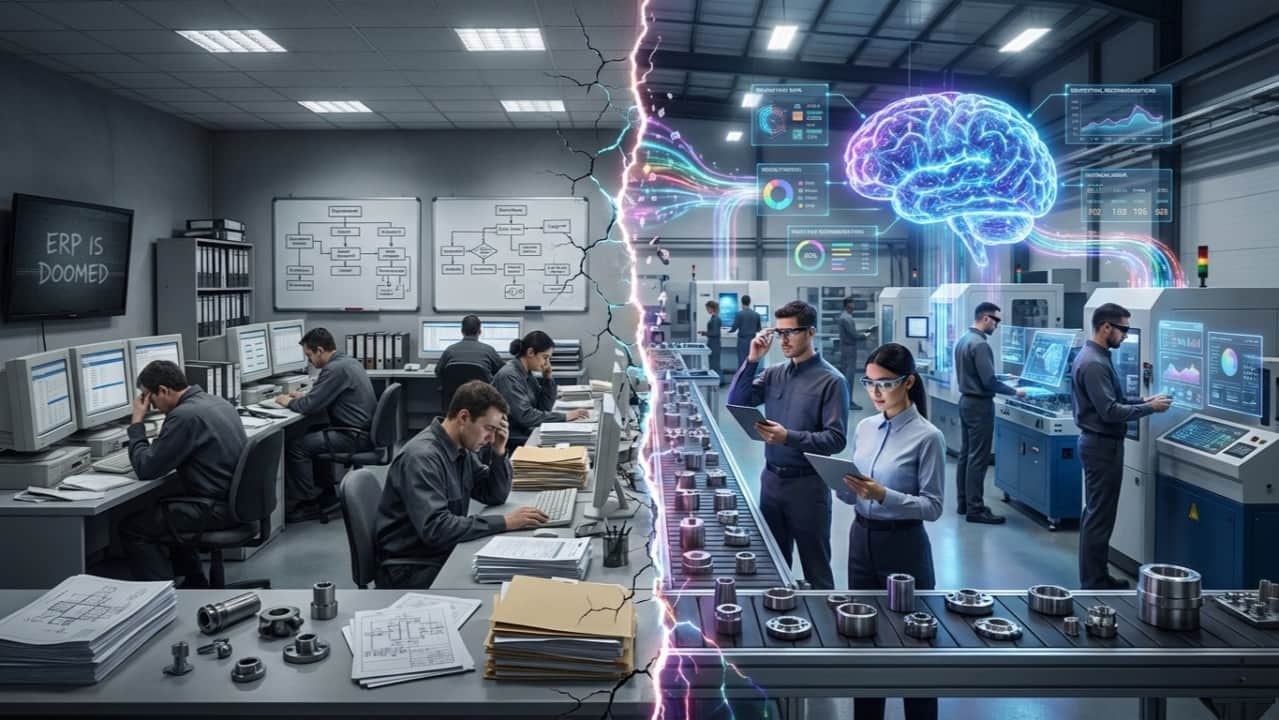
“ERP is doomed.”
When I write or say that, people react.
Some ERP vendors get defensive. Some customers get worried and ask: “Wim, are you saying ERP will disappear?” “Are you building a new ERP at Quotation Factory?”
The short answer: no. ERP will not vanish tomorrow. And Quotation Factory is not becoming an ERP system.
What I am saying is this:
The way we think about ERP today is fundamentally incompatible with an AI-driven world - especially in high-mix, low-volume (HMLV) environments.
And in HMLV, that mismatch isn’t a small annoyance. It’s a growing brake on your competitive advantage.
This article explains why.
The Reality of High-Mix, Low-Volume vs. Traditional ERP
If you run a high-mix, low-volume operation, your world looks like this:
- Many product variants
- Lots of exceptions
- High context: every order feels “a bit different”
- Limited standardization
That’s exactly the opposite of what traditional ERP likes.
Most ERP systems, if we strip away the marketing, are:
- A user interface
- On top of a relational database
- With predefined, hard-coded processes in between
This architecture evolves linearly. Release after release, customization after customization, within a fixed process model.
Meanwhile, AI evolves exponentially.
So you get a growing tension:
- Your business reality: more variants, more exceptions, more context
- Your ERP reality: rigid processes, static data models, slow change
And here’s the core paradox:
All that messy variation that makes ERP uncomfortable is actually perfect fuel for AI.
Argument 1: Software (Especially Simple Software) Is Becoming a Commodity
Most ERP systems are architecturally simple:
- CRUD operations on data (create, read, update, delete)
- Some business rules
- A stack of screens and reports
That kind of logic is increasingly easy to generate automatically.
With AI-assisted development and low-/no-code tools, you can now:
- Describe what you want in natural language
- Let AI generate data models, APIs, and basic user interfaces
- Iterate much faster than a traditional vendor can implement and customize for you
As long as the software can be clearly described, it can often be generated.
This means:
- The differentiation of many existing software products will disappear
- The value shifts from owning the right software to using AI intelligently You’ll generate systems that fit your current reality, instead of bending your reality to fit a static system
So the question changes from:
“Which ERP system should we buy?”
to:
“How do we use AI and our data to generate the systems we need right now?”
Argument 2: The Consultancy Business Model Will Break
Most ERP vendors don’t just sell licenses. They sell projects:
- Long implementations
- Customization cycles
- Change requests
- Upgrade projects
For you, that means:
- Months or years of implementation
- Lots of waiting time
- Planning around consultant availability
- Change as something painful and expensive
But AI-driven development sets a very different expectation:
- You describe a change
- The system adapts
- You get feedback in near real time
- You iterate quickly, as part of daily work
In other words, AI makes continuous change normal.
Consultancy, by definition, is batch-based:
- You plan a scope
- You schedule people
- You execute in chunks
- You wait for the next “window” to change things again
So the bottleneck becomes clear:
Not the technology But the business model of your software supplier
Your expectation will be: “Why can’t this change be applied now?” Their reality will be: “We can schedule a consultant next month.”
That gap will only grow.
Argument 3: We Will No Longer Accept “Dumb” Systems
Today, many business systems - ERP, CRM, MES - behave like this:
- They register data
- They validate data
- They report data
Useful, but fundamentally reactive. They don’t:
- Truly understand what’s going on
- Anticipate problems
- Suggest the best decision
- Act autonomously on your behalf
At the same time, you see what modern AI can do:
- Understand complex inputs (text, drawings, 3D models)
- Predict outcomes
- Provide high-quality recommendations
- Take autonomous actions within defined boundaries
Once you get used to that level of intelligence, a traditional ERP system starts to feel… dumb.
Here’s the key shift:
The real value moves from the system itself to the intelligence layer above it.
AI is actually very good at:
Generating “dumb” systems (simple workflows, forms, data structures)
- Orchestrating those systems
- Using them as tools, not as the center of the universe
So ERP, CRM, MES become plumbing.
The strategic layer is the AI that:
- Understands context
- Connects data from different systems
- Advises or decides what should happen next
- Automates actions across your tool landscape
The question then becomes:
Not “Which ERP has the most features?” But “Which intelligence layer helps us make and execute better decisions across everything we use?”
Argument 4: Process-First Thinking Becomes the Brake
ERP is built on process thinking:
- Define a standard process
- Model it in the system
- Optimize and enforce it
- Avoid customization as much as possible
That works in stable, high-volume environments with limited variation.
But a high-mix, low-volume business runs on:
- Deviations from the process
- Context-specific decisions “It depends” situations
- Custom combinations of machines, materials, lead times, and partners per order
If you keep thinking “process first”, you end up forcing reality through a rigid funnel:
- Every exception becomes a problem
- Workarounds multiply
- Master data and configurations explode
- People start living in Excel and email around the ERP, not inside it
AI, on the other hand, is naturally context-first:
“Given this order, this customer, these constraints - what is the best decision now?” It thrives in situations where the answer is not always the same.
So:
- Companies that stay locked in process-first tools will slow down
- Companies that move to context- and decision-first systems will accelerate
In high-mix, low-volume, that’s the real competitive battle.
From ERP-Centric to AI-Centric
Putting it all together, here’s the transition I see for HMLV companies:
From ERP-centric to AI-centric ERP moves from the “center of gravity” to just one of the tools that AI uses to store and execute decisions. From process optimization to decision optimization The goal shifts from “get everyone to follow the process” to “help everyone make the best decision in context, and automate more of those decisions over time.” From selecting software to using data in context Instead of spending months comparing feature lists, you’ll focus on:
ERP will still exist. But it will:
- Lose its central role rapidly
- Increasingly be experienced as a brake rather than an enabler
Why?
Because:
ERP was built for stability. AI is built for change.
And the world you operate in - high-mix, low-volume manufacturing - is becoming less stable, more variant, more interconnected.
What This Means for Metalworking Companies
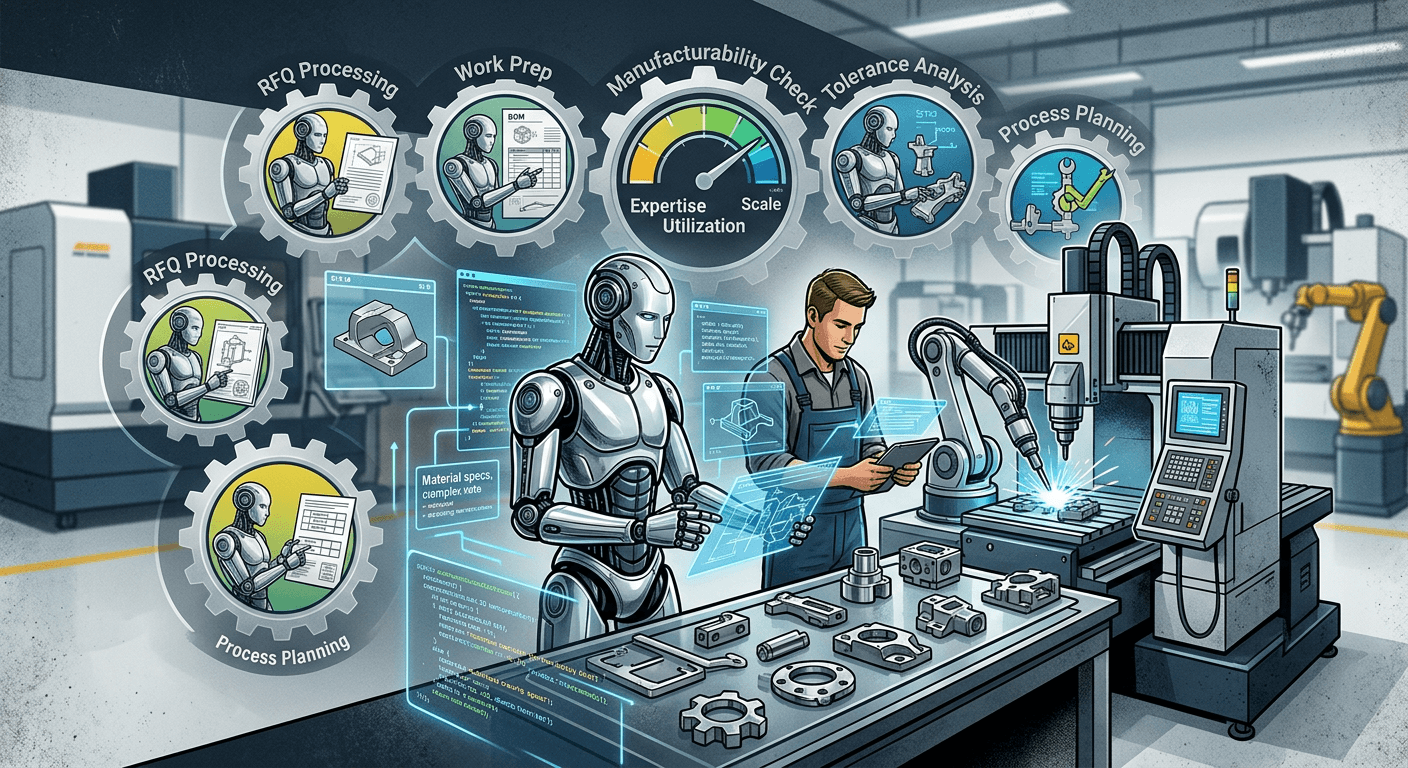
At Quotation Factory, we see this most visibly in the inquiry → quotation → order chain for metalworking companies: a lot of variation, a lot of expertise, and a lot of pressure on speed and accuracy.
Our mission is not to replace ERP, but to re-center the system landscape around intelligent decision-making, using AI to:
- Understand complex customer inquiries
- Assess manufacturability in your unique factory
- Automate estimations and quotations
- Connect seamlessly to ERP and CAM, without manual retyping
- Turn your data into a strategic asset instead of static records
In other words:
We treat ERP as one of the endpoints in the chain - not the brain of the company.
Average vs. Leading Teams
Average teams try to patch their ERP: Leading teams rethink the architecture:
The technology is ready. The real question is: are we ready to let go of ERP as the center of everything?
A Gentle Challenge
So when I say “ERP is doomed,” I’m not predicting an overnight collapse.
I’m inviting you - especially if you run a high-mix, low-volume operation - to rethink:
- What should be at the center of your digital landscape?
- Where is your real competitive advantage: in the brand of your ERP, or in the intelligence of your decisions?
- How long do you want to depend on batch-based consultancy in a world that can change itself in real time?
If you’re curious what an AI-centric, decision-first approach could look like in your quotation and order-intake processes, that’s exactly the journey we’re on at Quotation Factory.
Let’s keep exploring what that future can look like - before your “stable” systems quietly become your biggest constraint.
Wim Dijkgraaf - Founder and CEO at Quotation Factory